Sage Green Kitchen Ideas: Shades, Cabinets, and Pairings for a Calm, Timeless Room
A sage green kitchen sits in a rare sweet spot. It is a colour, but it behaves like a neutral. It brings the calm of nature into the busiest room in the house, and it pairs with warm wood, white stone, brass, black hardware, and even dark grey. This guide covers the whole job: choosing the right shade, picking cabinets, pairing walls, worktops, tiles, and hardware, and avoiding the mistakes that make a soft green kitchen feel dull or heavy.
Wondering what colours go with sage green kitchen units? The short answer is warm wood, white stone, brass, black hardware and dark grey, and the ‘Colours That Work With Sage Green’ section below works through each pairing.
What a Sage Green Kitchen Actually Looks Like
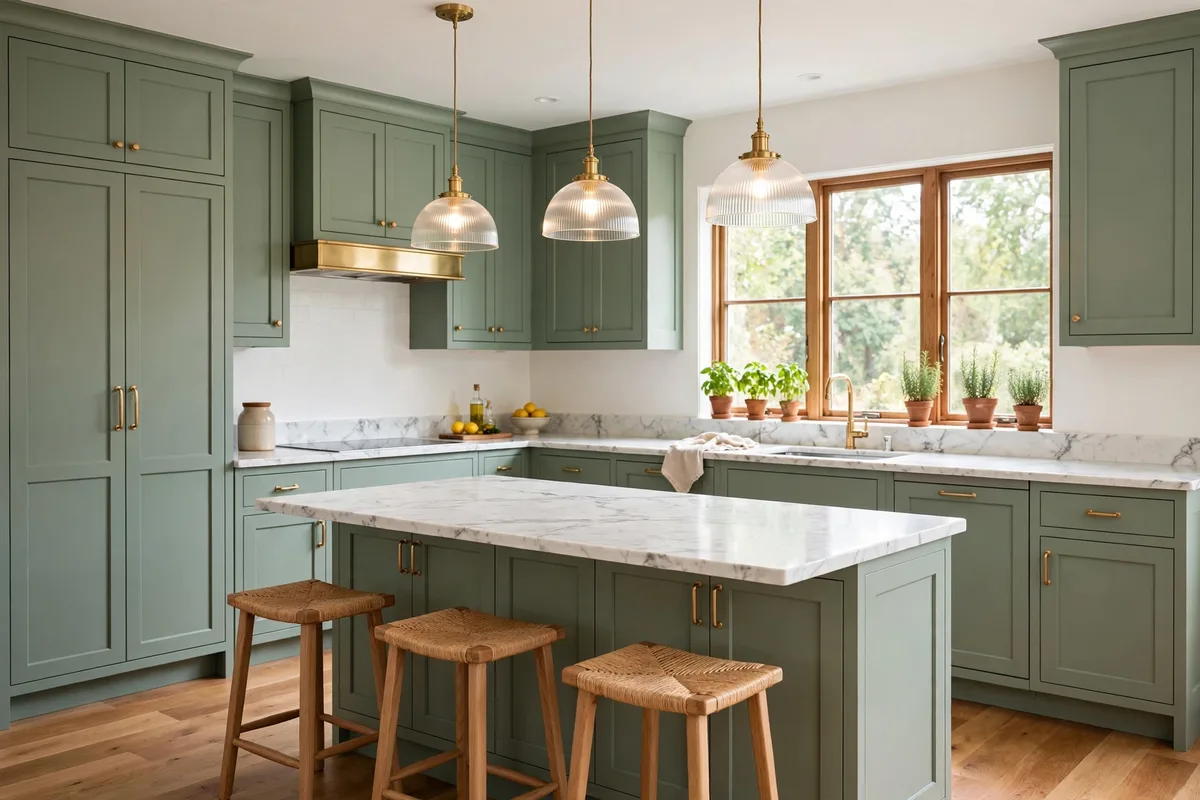
Picture cabinets in a soft, dusty green with a hint of grey, warm white walls, a pale stone or oak worktop, and brass handles catching the light. Nothing matches too perfectly, and nothing fights. That is the core sage green look: calm, natural, and lived in.
Sage works because it sits between green and grey. It is muted and softened, with a slightly dusty quality, so it reads as a neutral in most light while still giving the room character that plain white or grey cabinetry cannot. It also ages gracefully: sage has been used in kitchens for decades and still looks current.
It suits almost every style: quietly traditional as a Shaker kitchen, entirely modern with flat fronts and stone, and right at home in a country farmhouse with cream walls, open shelving, and a farmhouse sink.
Getting the Shade Right: Classic, Deep, and Blue-Leaning Sage
“Sage” is used loosely, and the differences between shades matter more than people expect. Learn the three broad families before you commit.
Classic sage is soft and greyed, calm and understated. It is the easiest to pair, and it suits small or dim rooms because it never overwhelms.
Deeper, richer sage has more green in it and a stronger presence. It suits larger kitchens and looks beautiful against pale stone worktops, but in a small or dark room it can feel heavy unless worktops and walls stay light.
Blue-leaning sage feels fresher and more contemporary. It suits modern kitchen designs and rooms with good natural light, which brings the tone to life. In a north-facing room with cool light, test it carefully, because a blue-leaning sage can read colder than you expect.
The light in your own room plays a bigger role than any photo. Always view samples in your own space, against your own flooring and worktop, in daylight and under your kitchen lights, before you approve the finish. A shade that looks soft in a showroom can look grey, yellow, or much darker beside your own surfaces.
If you want named shades to start sampling from, paint guides keep returning to the same handful. At the palest end, Farrow and Ball Mizzle reads as a warm grey-green, ideal for smaller kitchens. Pigeon sits slightly deeper, a true grey-green that works beautifully with marble and brass fittings. Vert de Terre and Lichen are gentle mid-tone sages, Cooking Apple Green brings a soft olive warmth suited to farmhouse kitchens, and Treron is a darker grey-green for modern schemes. From other brands, the names that come up most are Sherwin-Williams Clary Sage and Dried Thyme and Benjamin Moore Saybrook Sage. Treat these as a sampling shortlist, not a final choice. For cabinets, a scrubbable eggshell finish is the practical choice, since kitchen doors get touched, splashed, and wiped far more than walls.

Sage Green Cabinets: Shaker, Slab, and Handleless Styles
Cabinets are where sage green makes the greatest impact. A hand-painted finish gives sage a depth and texture that a standard factory finish often cannot match, because the paint settles into the grain and the panel details.
Shaker is the most popular pairing with sage green, and for good reason. The simple panelled door lets the colour do the work, and it suits farmhouse, transitional, and modern kitchens alike. A sage green Shaker kitchen with brass hardware, a marble or timber worktop, and warm wood flooring is a genuinely enduring scheme.
Slab doors, flat and without panels, push the same colour in a modern direction. With simple hardware and a quiet backsplash, slab sage cabinets feel sleek and current rather than cottage-like.
Handleless cabinets go further still. Slim profiles, push-to-open doors, and a stone worktop create an ultra modern sage kitchen where the colour itself is the only decoration. This works best with the fresher, blue-leaning sages and cooler accents like chrome or concrete.
For a balanced scheme, consider a two-tone approach: sage green on the lower cabinets and island, with lighter neutrals above. This grounds the space, draws the eye upward, and is now a defining modern sage look.
An IKEA kitchen can reach the same look by three routes that social media kitchens use again and again. First, IKEA’s own AXSTAD shaker front comes in a gray-green that reads as sage without any paint job. Second, paint the fronts yourself: IKEA METOD boxes (called SEKTION in the United States) take primer and cabinet paint well, and many DIY kitchens online are simply painted IKEA doors with new handles. Third, order custom fronts made to fit IKEA boxes from specialist companies, in painted finishes in nearly any colour, if you want a bespoke look on a flatpack budget. Whichever route you take, confirm whether your boxes are SEKTION or METOD before ordering fronts, since the two systems are not always interchangeable.
Rustic Sage Green Kitchen Cabinets: Farmhouse Warmth Without the Clutter
Rustic sage green kitchen cabinets are where the colour feels most at home. The recipe is simple: sage Shaker doors, natural wood, and handmade textures, held together by restraint so the room feels collected rather than cluttered.
A sage Shaker door with visible wood grain, or a hand-painted finish that shows slight variation, reads as rustic in a way a perfectly flat factory door does not. Pair them with butcher block or warm oak, because wood pulls out the warm yellow underneath sage and makes the room feel sunlit even on a grey day.
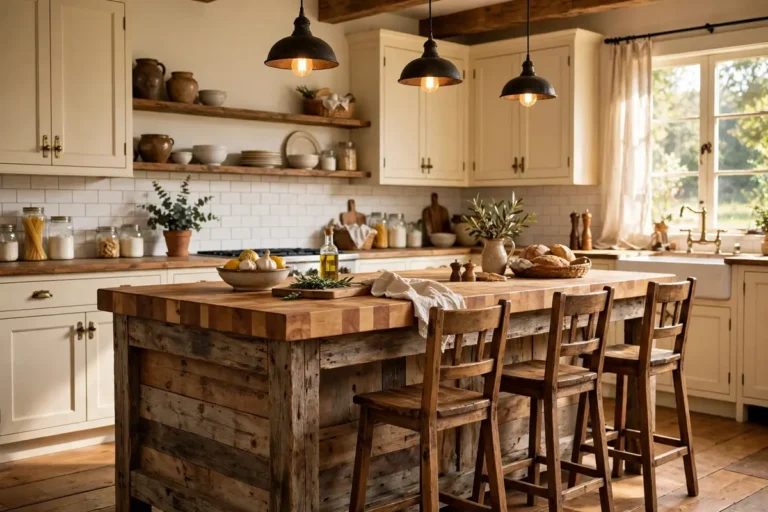
Then add the farmhouse pieces that earn their place: open shelving in a matching wood tone, a farmhouse or Belfast sink, a range cooker, and cream walls that let the green breathe. Copper or lacquered brass accents add a rustic warmth that completes the look. Display plants, woven textures, and plain porcelain dishes on the open shelves, and keep the rest behind closed doors so the shelves never fill edge to edge.
The warning for rustic sage is clutter. Farmhouse style fails through clutter, not colour. Edit hard: one wooden board left out, one plant on the windowsill, one basket for storage. It should feel like a working farmhouse kitchen, not a shop display.
Dark Grey Kitchen Cabinets With Sage Green: The Two-Tone Balance
Dark grey kitchen cabinets paired with sage green sound risky, and done badly they are: two muted tones can combine into a room that feels dark and heavy. Done well, they are one of the most sophisticated pairings available, because grey pulls out the cool tones in sage and gives the scheme a contemporary edge.
The method is two-tone, not half and half. Use sage green for the lower cabinets to ground the space, and a lighter grey or white for the upper cabinets to keep the most visible part of the room feeling open. Or keep the perimeter cabinets in a soft greige and paint just the island sage, which gives you the colour without committing the whole room to it. Cabinet ranges sell grey shades like Winchester Grey and West Point Grey as direct matches for sage Shaker lines, which shows how established this pairing is.
Balance and light do the rest of the work. Dedicate most of the room’s surfaces, especially walls and ceiling, to a light, bright neutral like white or cream, so sage and grey become intentional layers on top rather than the overwhelming base. Layer your lighting: ambient overhead light, bright strips under the upper cabinets to light the worktops, and warm pendants over the island or sink. Check undertones first: a warm grey beside a cool sage, or a blue grey beside a yellow sage, will fight, and two samples side by side reveal it at once.
If your kitchen is small or short on daylight, keep the dark grey to accents only: an island base, a tall pantry unit, or the lower run, with everything else light. The pairing should feel grounded, never gloomy.
Sage Green Walls Instead of Cabinets
Not every sage green kitchen needs sage green cabinets. Painting the walls in sage while keeping cabinetry in cream or warm white is a softer, more flexible approach, and it answers one of the most common homeowner questions: can you have a cream kitchen with sage green walls? Yes, and it is one of the most elegant combinations available.
Warm cream cabinetry against sage walls creates a layered feel that sits naturally in period homes and open-plan spaces. White cabinets with light sage green walls are the crisper version of the same idea: the green gives warmth and nature, the white bounces light around and keeps the room feeling spacious. Checkerboard floor tiles add personality without disturbing its calm.
For a bolder move, consider colour drenching: running sage across walls, ceiling, and cabinetry for an immersive, enveloping feel. This suits smaller kitchens, where one unified tone feels cohesive rather than cramped, as long as worktops stay light and flooring stays warm.
Walls are also the low-commitment test. If you are unsure about sage cabinets, paint one wall first and live with it for a week. You will learn more from that than from any number of photos.
Wall ideas beyond plain paint give sage walls extra character. Wood panelling on one wall adds texture and pairs beautifully with sage cabinets. A limewash or shiplap wall in a green palette adds a handmade, cottage texture that flat paint cannot match. Running wallpaper or panelling up to the ceiling makes a compact room feel intentional, a trick social media calls the jewel box kitchen. A sage-washed wall, paler sage walls against mid-tone sage cabinets with a darker sage-veined worktop, creates a disciplined tone-on-tone scheme.
Colours That Work With Sage Green
Sage is one of the most pairable kitchen colours, because it sits between a neutral and a colour.
Cream and warm white are the natural partners. They add warmth without competing, and the contrast is soft enough to feel considered rather than stark. It suits traditional and modern schemes alike, and it is the safest first choice.
Warm wood sits instinctively alongside sage. Lighter oak creates a relaxed, Scandinavian-influenced feel, while darker timber like walnut adds depth and a slightly richer character to the same cabinetry.
Brass and aged gold bring out the warmth in sage and give the kitchen a richer, more inviting quality. It works on taps, handles, light fixtures, and range hood details.
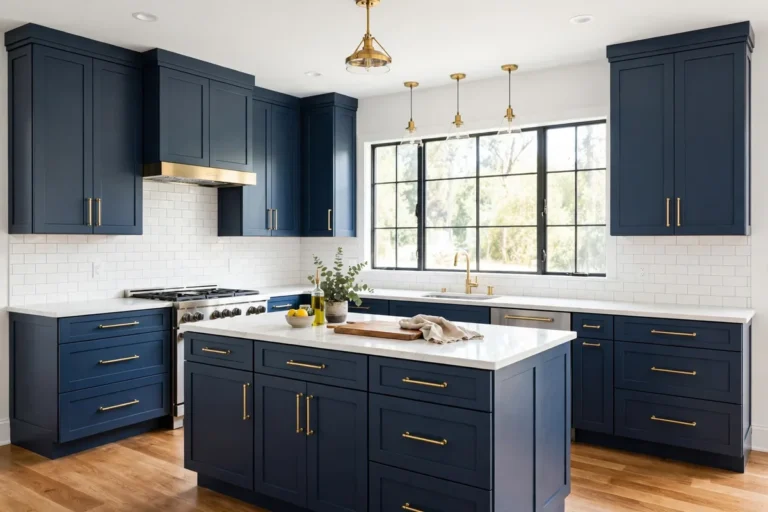
Navy works well as a bold contrast accent: an island in a deeper tone, or open shelving against sage walls. It adds definition without interrupting the calm of the overall palette. For painted-cabinet inspiration in deeper tones, see our guide to blue kitchen cabinets, which covers navy and shaker styles that pair well with sage warmth.
Cooler tones like bright white, chrome, and concrete push the scheme toward something more contemporary and sharper-edged. Choose cooler accents and handleless cabinetry for an ultra modern design. Black works the same way in smaller doses: black hardware, light fixtures, or a statement black range hood create a striking contrast against sage cabinets, especially in modern kitchens where the design is more pared back. Softer accents like blush pink or terracotta, a planter, a dusty rust stool, blush linens, stop sage from reading cool where the kitchen opens onto a living space.
Worktops: Marble, Quartz, Timber, and Dark Stone
Worktops shape how a sage kitchen feels more than almost any surface, because they cover so much area. Three materials work best.
Pale marble or quartz creates a fresh, classic combination. White or light grey marble with soft veining sits beautifully against sage cabinetry and keeps the space feeling bright. Running white marble up the wall as a backsplash behind stove and sink is an elegant version of this pairing.
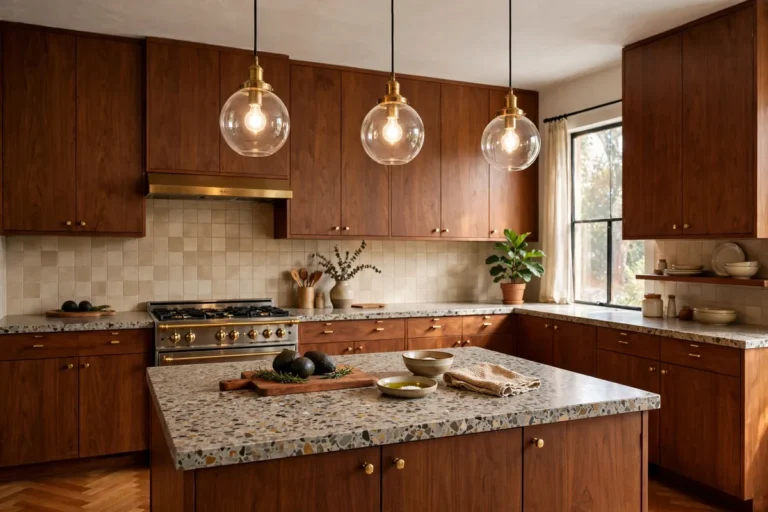
Timber introduces warmth and texture. Oak worktops are a natural match: relaxed, tactile, and suited to Shaker and contemporary styles alike. Butcher block is the rustic version of the same idea, and it pairs especially well with farmhouse sage kitchens.
Darker stone like heavily veined marble, honed granite, or a rich quartzite creates deep contrast and gives the kitchen a more architectural, considered quality. Black soapstone is the boldest version, softened by brass hardware and warm wood. If you choose a dark worktop, keep the walls and upper cabinets light so the room stays balanced.
Backsplash and Tile: Metro, Zellige, and Patterned Options
The rule is simple: if cabinetry is the statement, keep tiles considered; if walls are where you want interest, a bolder tile against neutral cabinetry gives the same impact with more flexibility.
Cream or white metro tiles are a reliable choice for a splashback: clean, timeless, and versatile across both traditional and modern schemes. A soft sage subway tile backsplash is the tonal version, and it works in virtually any kitchen.
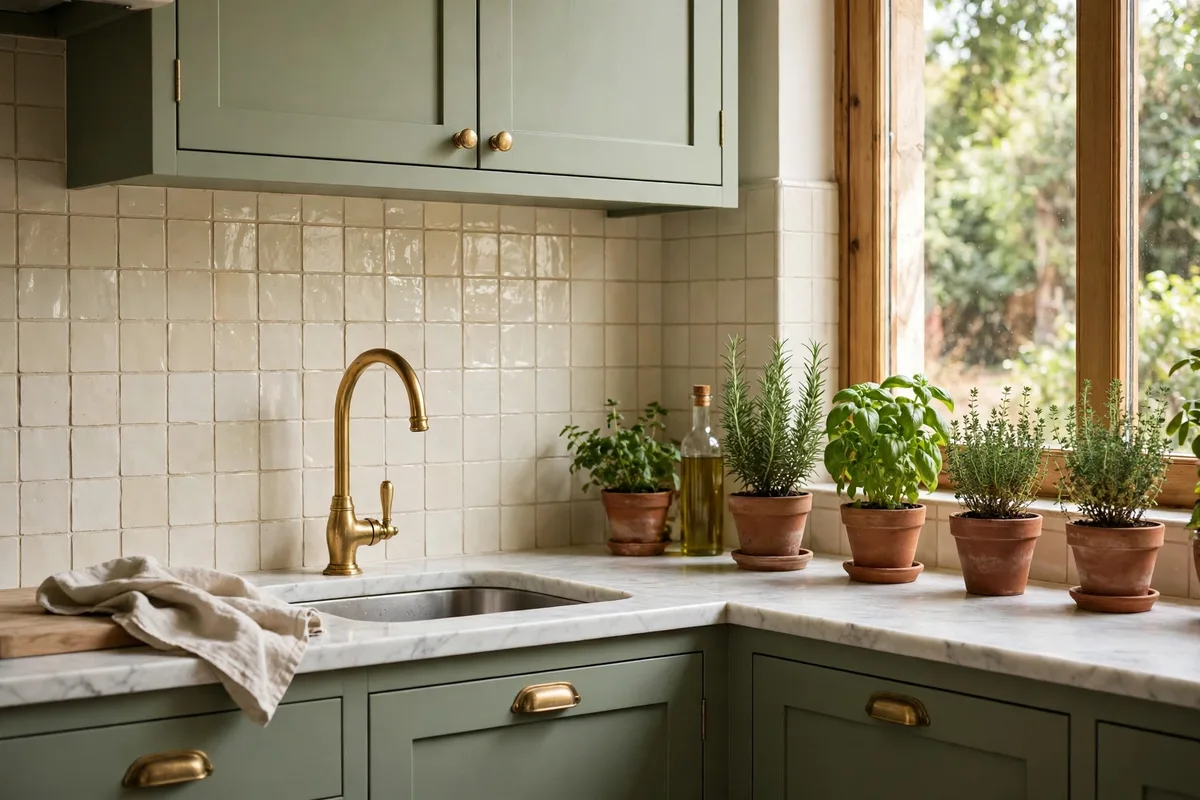
Zellige tiles in warm cream or terracotta tones add handcrafted texture and a sense of depth. Zellige’s slight irregularity catches light in a way that flatters sage, and matching zellige with wall paint creates a cohesive modern look.
Stone-effect tiles in soft grey or limestone sit quietly alongside sage for an understated luxury feel. Pattern adds the next layer: herringbone or chevron layouts, mosaic patterns, and fluted marble tiles all add depth and character while staying true to the soft, calming essence of sage green. A patterned tile behind the stove, or a single band of it, gives you the effect at lower cost than tiling a whole wall.
Hardware and Finishes: Brass, Nickel, and Black
Because sage is subtle, hardware details become more noticeable.
Brushed brass or warm gold handles bring out the warmth in sage and give the kitchen a slightly richer, more inviting feel. It extends naturally to taps, towel rails, and cabinet pulls. A gold faucet against sage cabinets with a white marble worktop is a true focal point.
Brushed nickel or chrome creates a cleaner, sharper look that works well in modern sage green kitchens where the aesthetic is more pared back. Matte black handles, taps, and pendants give sage a modern edge without chrome’s formality, and pair strikingly with flat-fronted cabinets.
Handle styles matter as much as finishes. Trim handles, D-handles, knobs, and handleless rail systems each change how a sage kitchen reads: knobs and cup pulls lean traditional, slim bars lean modern, and handleless rails suit the sleekest schemes. Choose one finish and repeat it across handles, taps, and lighting so the details feel intentional rather than collected by accident.
Flooring That Grounds a Sage Green Kitchen
Flooring rarely gets its own section in sage kitchen guides, but it decides whether the room feels warm or cold underfoot. Warm wood is the natural choice: light oak floors keep a sage kitchen bright and Scandinavian in feel, while walnut or darker timber adds richness that suits deeper sage tones. A herringbone wood floor does extra work in a modern sage kitchen, warming up flat-front cabinets and a minimal scheme.
Stone and tile floors work when they stay in the same muted family. Marble floor tiles elevate the scheme, especially with soft grey tones. Checkerboard tiles with white cabinets and sage walls are a classic, fresh choice.
Avoid a floor that fights the cabinets: a strongly patterned or very dark floor beside deep sage doubles the room’s visual weight. If cabinets are the statement, let the floor stay quiet, and vice versa.
The Sage Green Island: A Two-Tone Focal Point
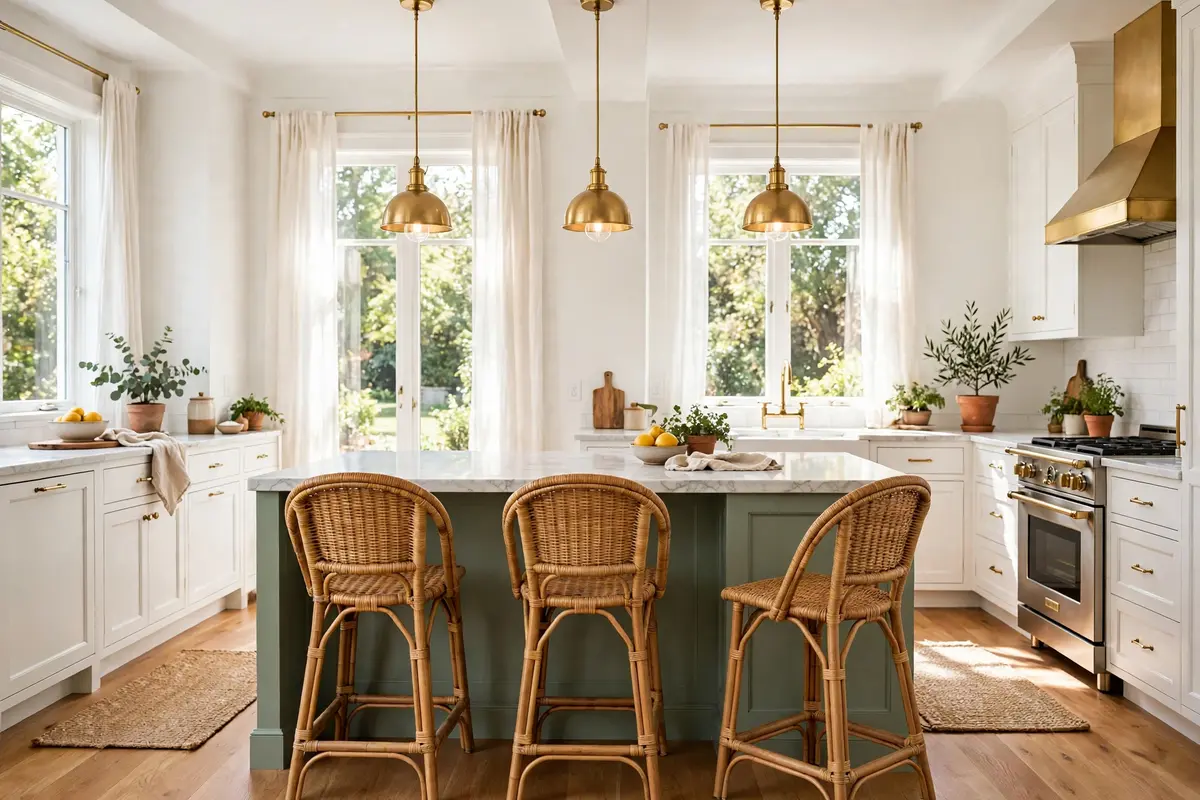
The island is where a sage green kitchen gets its focal point, and it is the easiest place to use two tones well. Paint the island sage while the perimeter cabinets stay white, cream, or soft grey, and you get the colour without committing the whole room to it. This is also the arrangement that settles the “sage or grey” debate in shared homes: everyone gets their colour, and the room still looks designed rather than compromised.
A well-planned island paired with the right pendant lighting can hold the whole room together: brass or black pendants over a sage island, a timber or stone top that contrasts gently with the base, and seating that repeats one warm accent from elsewhere in the room, like rattan stools or a dusty rust cushion. Keep the island top clear except for a wooden board or a ceramic bowl, so it reads as workspace first, display second.
In a small kitchen, a slim island or a peninsula in sage gives you the same focal-point effect without blocking walkways. In open-plan spaces, repeat one living-room element, a wood tone or metal finish, on the island to tie the spaces together.
Open Shelving and Storage in a Sage Kitchen
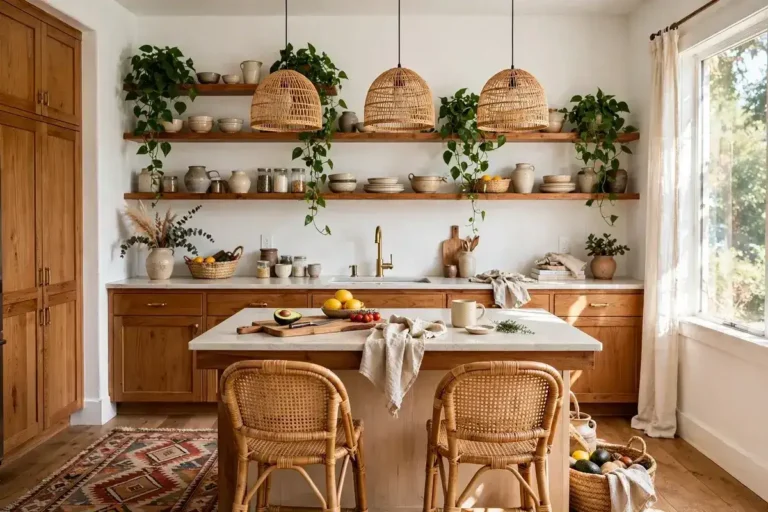
Open shelving suits sage kitchens because the calm colour lets displayed objects shine. Floating wood shelves let you show off ceramic bowls, wooden boards, glass jars, plants, and a few favourite cookbooks, which makes the kitchen feel personal and lived in.
The rule that keeps it from turning into clutter is the same as in any kitchen: display what you use and love, and keep the rest behind closed doors. Group items in odd numbers, leave breathing space, and repeat one material like wood or cream ceramic so the display feels tied together. Try it on one wall first, or remove the doors from a single upper cabinet as a test.
Behind the scenes, storage matters just as much. Modern internal storage solutions, soft-close pull-outs, drawer dividers, and pantry pull-outs, let you use every inch of cabinetry while keeping items neatly organised and easily accessible. In a sage kitchen this matters doubly, because the calm scheme depends on clear surfaces.
One honest note from social media: open shelving splits opinion. Many people love it in sage kitchens, but plenty of others say no to open shelves outright, usually because of dust and the pressure to keep everything display-ready. If you are unsure, the one-wall test above settles it better than any debate.
Small Sage Green Kitchens: Light, Reflection, and Layout
In a small kitchen, shade and layout have to work harder. Choose classic or pale sage over deep sage: lighter tones reflect light and keep compact rooms open.
Keep worktops and walls light, use reflective finishes where possible, and choose warm flooring to stop the scheme feeling heavy. A two-tone layout helps too: sage lowers or island with white or pale grey uppers draws the eye up and suggests higher ceilings. Open shelving on one wall instead of a full run of uppers keeps the room from feeling boxed in, as long as the shelves stay edited.
Run cabinets to the ceiling, use a slim island or fold-down counter, and put the brightest task lighting under uppers so worktops never sit in shadow.
Social media calls the best version the jewel box kitchen: instead of apologising for a small space, treat it like a jewel box, with bold colour, panelling to the ceiling, curated accessories, and quality appliances. A kitchen is good because it works for its owner, not because it is large.
Modern Sage Green Kitchens: Flat Fronts and Clean Lines
Most sage kitchens online lean cottage, but sage goes modern when you change the cabinet language. Flat-front cabinets with no Shaker detail, cream uppers over olive or sage lowers, a black faucet instead of brass, and a herringbone wood floor doing the warming up: that is modern sage without the English countryside association.
Keep accessories minimal to let the colour do the work. Blue-leaning sage suits this approach, with a stone worktop, integrated appliances, and slim or handleless cabinets. Black marble-effect surfaces against deep sage, plus chrome and concrete accents, push it further toward contemporary.
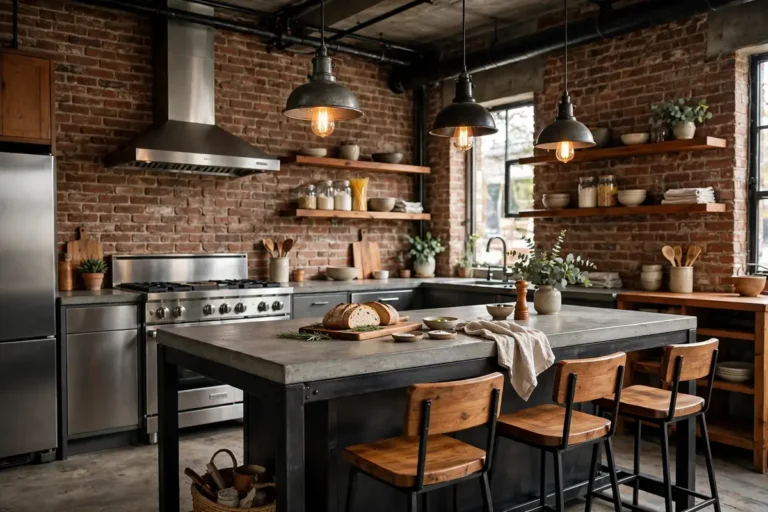
An industrial version works the same way: sage cabinets, metal hardware, exposed brick or beams, and a minimal palette. The key in every modern version is restraint: one sage tone, one worktop material, one metal finish, and nothing extra competing for attention.
Traditional and Country Sage Green Kitchens
This is the combination most people picture, and it has lasted because every element earns its place. Panelled Shaker doors in sage with brass hardware, a marble or timber worktop, and warm wood flooring work as well in a country farmhouse as in a period townhouse.
The details are specific: classic sage, cream walls, a Belfast or farmhouse sink, open shelving, a range cooker. Copper or lacquered brass adds rustic warmth, and a dresser or freestanding pantry adds the collected, unfitted feeling country kitchens do best.
In a period home, sage complements existing character: original woodwork, stone floors, uneven plaster, where stark white feels cold and bold colour feels imposed. Victorian terrace and farmhouse projects return to the same formula: sage cabinets, warm neutrals, natural wood, and one standout feature like a seating area on the island’s back.
Sage Green and White: The Crisp Classic
If you want one pairing that cannot go wrong, it is sage green and white. Sage walls with white details create a clean, crisp look: light sage makes white accents pop, and a white backsplash or worktop completes a bright, open feel.
It works both ways: sage cabinets with white worktops keep cabinetry the star while the room stays airy. White cabinets with sage walls flip the emphasis: the green becomes the backdrop, the white bounces light, and the room feels larger than it is. Brass fixtures and pendants enhance the palette, and a sage island with a white top ties both directions together.
White also rescues sage in difficult light: in a small or north-facing kitchen, white uppers, worktop, and walls around sage lowers stop green reading grey or dull. When in doubt, add more white, not more green.
Lighting That Keeps Sage From Going Grey
Sage is a chameleon: in warm light it reads soft and green, in poor or cool light it slides toward grey. Lighting is therefore colour management, not decoration.
Start with natural light: note where daylight falls before choosing a shade, because the scheme should respond to the space. A room with strong southern light can carry deep sage; a darker room needs classic or pale sage and lighter surfaces around it.
Then layer artificial light: ambient overhead, bright under-cabinet strips so worktops never sit in shadow, and brass or black pendants over island or sink as a warm focal point. Warm white bulbs matter more than the fixture itself, because cool white light flattens sage into grey. Never rely on one ceiling fixture alone: it casts shadows and dulls nuanced colour.
Styling a Sage Green Kitchen: Plants, Textiles, and Natural Touches
Because sage is subtle, styling becomes more noticeable, and natural materials do this job best. Terracotta planters, linen textiles in warm neutrals, and ceramic bowls in muted earth tones reinforce the organic quality of sage without making the space feel themed.
Sage ties back to window plants and the garden outside, so the room reads as one connected space. Herbs on the sill, a trailing plant on shelving, and one larger terracotta pot by the door are enough; living green echoes the cabinets without competing.
Textiles soften the hard surfaces: linen napkins in a warm solid, cotton dish towels in a muted stripe or botanical print, and a washable rug by the sink in a pattern that repeats one colour from the room. Keep one repeated warm accent, terracotta or brass, across textiles, planters, and hardware. And keep surfaces edited: a sage kitchen looks best when the styling is a handful of loved objects, not a display.
Accessories do not need to be expensive to look right. Creators sharing sage kitchens online regularly source accessories from charity shops, vintage shops, and budget home stores: a secondhand bowl, vintage brass tray, woven basket, or plain terracotta pot suit sage better than a matching new set. That is also why sage kitchens are easy to build slowly, one thrifted piece at a time.
Sage Green Kitchen Mistakes to Avoid
The most common mistake is choosing the shade from a photo: a soft-looking shade can read grey, yellow, or much darker beside your own flooring and worktop, so test samples in your own room first.
The second is pairing sage so dark the room goes heavy: two muted tones need a light neutral base and layered lighting, or the room feels smaller and gloomier than either colour alone.
The third is letting tiles fight the cabinets: a bold patterned tile, strong veining, and busy floor at once turn a calm scheme into noise. Pick one hero surface and let the rest stay calm.
The fourth is buying a full matching set at once. A sage kitchen looks best gathering character: ageing wood, warming brass, growing plants, vintage pieces mixed with new. A showroom-perfect single-tone set feels flat.
Sage Green Kitchen on a Budget: Paint, Handles, and High-Impact Swaps
Sage is budget-friendly because the colour does so much work you need not replace cabinets to get it. A hand-painted finish is the highest-impact swap: repainting existing doors in sage gives most of the new-cabinetry look for a fraction of the cost.
Handles are the next cheapest swap: wooden, brass, or matte black pulls change how the whole kitchen reads. Then change what surrounds the cabinets: a wooden board left out, a washable rug, linen textiles, and a few plants shift the room toward sage warmth without replacing a slab.
Spend where you touch daily and where it must last: a good rug that washes well, solid lighting that gives warm light, and seating that stays comfortable. Save elsewhere: paint, a patterned tile just behind the stove, thrifted boards, baskets, and ceramics. A single statement piece, like a brass pendant or a patterned rug, lifts the whole room, so put your money there and let small, natural touches fill the rest.
IKEA is the budget route seen most in social media sage kitchens: keep the flatpack boxes, paint fronts sage, swap handles for brass pulls, add wood shelves and a wooden worktop. One widely shared budget hack even turns an IKEA cube shelving unit into a kitchen island. The lesson: colour, hardware, and wood do the expensive-looking work, while the boxes underneath can be the cheapest part.
FAQs
What colour is best paired with sage green in a kitchen?
Cream, warm white, and natural oak are the most versatile pairings. Brass adds warmth and depth, navy works as a contrasting island or shelving accent, and dark grey grounds a two-tone scheme when the rest stays light.
What is the best worktop for a sage green kitchen?
Pale marble or quartz keeps it fresh and classic. Timber, particularly oak, adds warmth for Shaker and contemporary styles. Darker stone suits deeper sage tones, as long as walls and uppers stay light.
Is sage green a good kitchen colour?
Yes. Sage is calming, versatile, works across traditional and modern designs, and pairs naturally with a wide range of materials. According to the 2026 UK Houzz Kitchen Trends Study, blue is the most popular cabinet colour in renovated kitchens at 18 percent, followed closely by green at 17 percent.
What accessories work with a sage green kitchen?
Natural materials work best: brass hardware, terracotta ceramics, linen textiles, wooden accents, and plants. One repeated warm accent across planters, textiles, and hardware keeps it intentional.
What tiles complement a sage green kitchen?
Cream or white metro is classic. Warm zellige adds artisan texture. Soft grey or limestone stone-effect gives an understated luxury feel. Keep tiles considered if cabinetry is the focal point, and save bold patterns for the stove wall.
Can sage green work in a small kitchen?
Yes. Lighter, muted sage reflects light and keeps small spaces open. Keep worktops and walls light, use reflective finishes and warm flooring, and consider sage on lowers or island only, with lighter uppers.
What colour tiles go with a sage green kitchen?
Cream or white metro is safest for traditional and modern schemes. Warm cream or terracotta zellige adds handcrafted texture, soft grey or limestone stone-effect stays understated, and a green subway backsplash gives a tonal look. Keep pattern to one area, like the stove wall, in herringbone, chevron, or mosaic.
What colour walls go with sage green cabinets?
Warm white, cream, and soft beige are safest, adding warmth without competing. Light grey gives a cooler contemporary feel, and a sage wall behind white cabinets flips the scheme into an equally classic combination.
Will a sage green kitchen look dated in a few years?
Sage is safer than most colours because it reads as a softened neutral, not a fashion colour, and has been used for decades. The risk is the shade: very grey or yellow sages feel tied to a year, so choose classic sage, test it in your own light, and keep surrounding materials timeless.
Can I mix sage green with dark grey cabinets without the room going dark?
Yes, with two rules: keep most surfaces light, especially walls and ceiling, and use dark grey on lowers or island only, with lighter uppers. Layered lighting does the rest, and matching undertones stop the colours fighting.
Get home ideas in your inbox
Practical home improvement ideas and DIY guides, once in a while. No spam.