
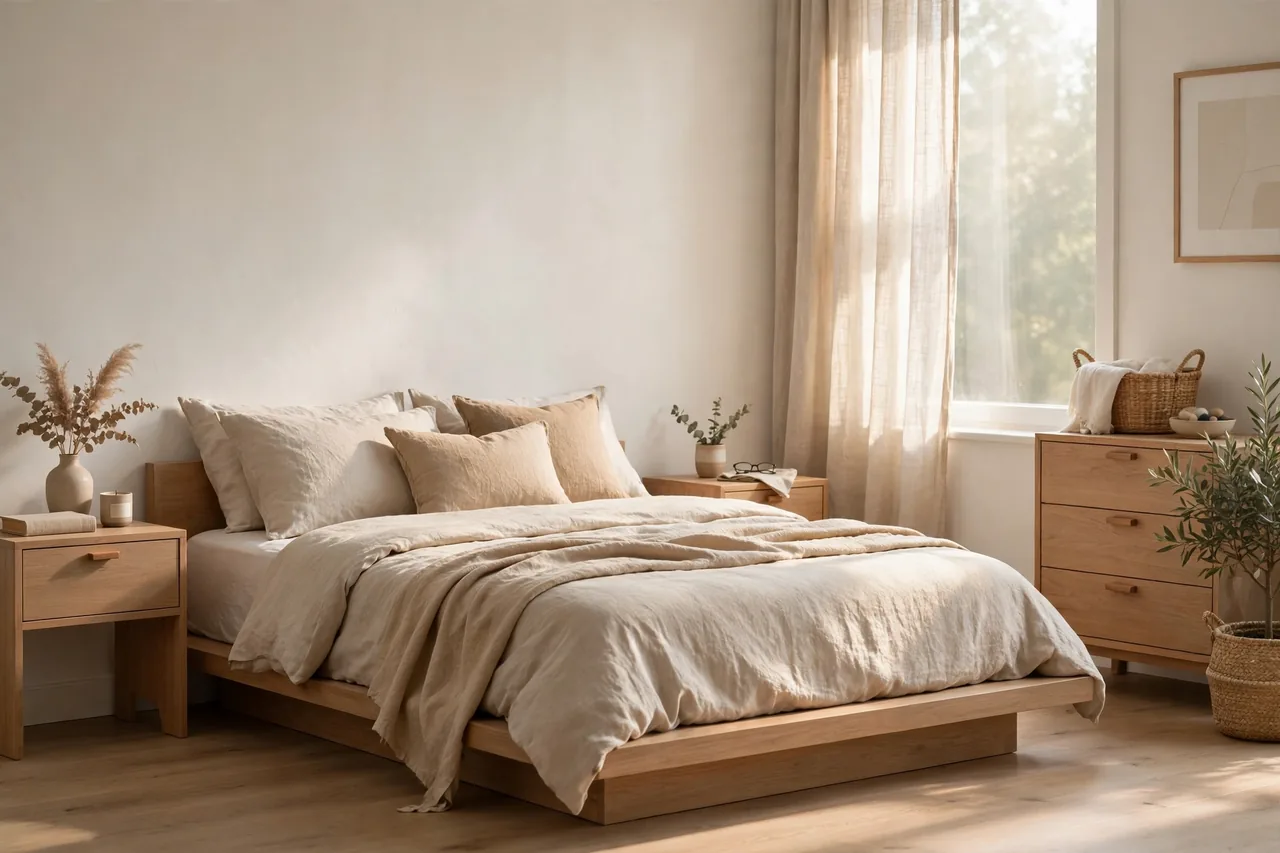
Modern Bedroom Ideas: Clean Lines, Warm Neutrals, and Rooms That Feel Calm
A modern bedroom is not a showroom. It is a room with clean lines, honest materials, and nothing extra fighting for attention. The best modern bedroom ideas start with what the room must do, sleep, dress, and unwind, and then choose furniture, colour, and light that serve those jobs quietly. This guide stays style first: what modern means, how contemporary differs, how neutral and dark rooms work, and how industrial fits in.
What Makes a Bedroom Modern (and How Contemporary Bedrooms Differ)
Modern is a fixed style, not a synonym for new. It comes from clean straight lines, geometric shapes, flat surfaces, and minimal ornament. A modern bedroom keeps furniture low and simple, lets one or two materials do the talking, and leaves open space around the bed.
Contemporary bedroom design moves with the time. It borrows from what is current, mixes materials, welcomes a trend accent, and changes more often. That is why guides sometimes use the two words as if they mean the same thing: furniture shops often label them interchangeably, while design guides treat modern as the fixed era and contemporary as the moving present. A third term helps. Transitional blends modern and traditional, with clean soft lines and neutral walls. One large statement art piece, rather than a gallery wall of small frames, suits all three, because it gives the eye one place to rest.
| Style | Basis | Colours | Furniture | Flexibility |
|---|---|---|---|---|
| Modern | Fixed era style | Neutrals plus black and white | Low, straight, simple | Low, rules stay steady |
| Contemporary bedroom | Current trends | Neutrals plus one trend accent | Sleek, mixed materials | High, changes with time |
| Industrial bedroom | Workshop and loft roots | Charcoal, brick, warm wood | Raw metal and reclaimed wood | Medium, raw but warm |
Start With the Bed: Low Frames, Clean Headboards, and One Focal Wall
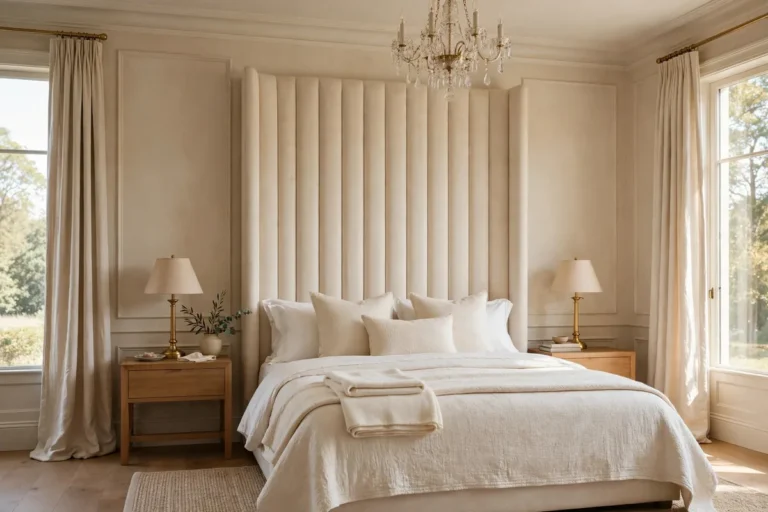
The bed is the decision everything else follows. In a modern bedroom it sits low, on a platform or low profile frame, with a headboard that is clean rather than carved. Upholstered headboards in linen or boucle soften the look, while a wood or leather headboard keeps it sharper. Either way, the headboard wall becomes the focal wall, and the rest of the room stays quieter.
A floating bed, which appears to hover on a recessed central support, is a newer modern option. Guides present it as especially good for smaller bedrooms, because the visible floor underneath makes the room feel lighter. A do it yourself upholstered headboard is a practical middle step: a board cut to size, padding and fabric fixed over it, hung on the focal wall. It adds softness without buying a new bed, and it suits renters who cannot change much else.
Neutral Bedroom Ideas: Warm Whites, Greige, and Soft Grey That Do Not Feel Cold
Neutral bedroom ideas fail when the room turns flat and cold. The fix is warmth, not more colour. Warm white, greige, soft grey, and warm taupe are the bases guides return to most, because they stay gentle under daylight and lamplight alike.
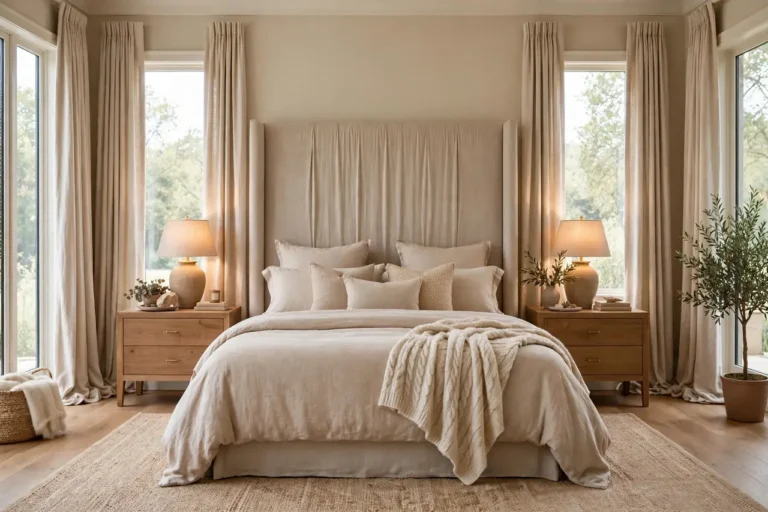
Three rules keep neutrals warm. Pick a warm undertone, not a stark clinical white, especially in a north facing room. Repeat one material or colour in three places, such as timber on the frame, the nightstand, and a tray, so the room feels tied together. Let texture carry what colour does not: linen bedding, a wool throw, and a woven rug give depth without a loud colour. For how daylight shifts a wall colour through the day, see our guide on how light changes wall colour. Test samples on two walls across a full day before committing, because a colour calm in morning light can turn cold under evening lamps.
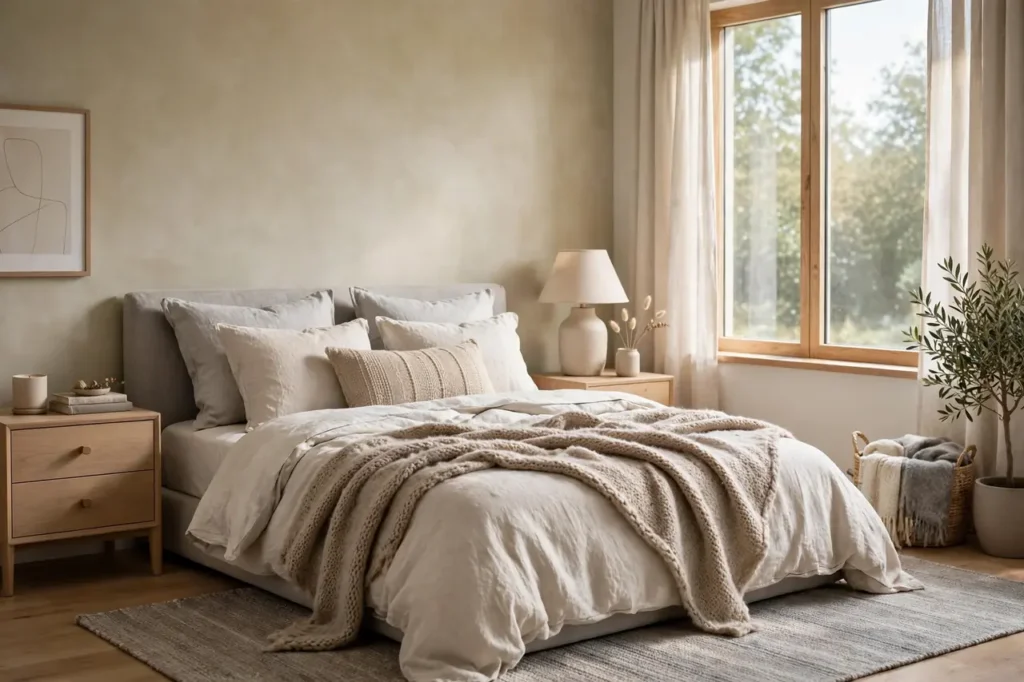
Contemporary Bedroom Colour Systems: One Base, One Accent, One Warmth
A contemporary bedroom colour system has three parts and no more. One light neutral base for walls, one mid tone for bedding and curtains, and one deeper tone or warm material for accents. That discipline stops a neutral room from feeling empty and a colourful room from feeling loud.
Accent systems give the room its character. Rust and terracotta make beige feel alive, especially against wood panels or a warm rug. Emerald with champagne gold reads richer and suits velvet or a single upholstered piece. Soft pastels, sage green, and dusty rose work as gentle accents when the base stays neutral. Pick one accent system, not two, and repeat it in just two places, such as the rug and the headboard. Panel and slat walls behind the bed add structure in the accent tone without a new colour, and a limewash accent wall gives a similar soft texture with paint alone.
| Palette system | Base | Accent | Where it works |
|---|---|---|---|
| Warm white and greige | Warm white walls | Timber and tan | Almost any room, any light |
| Soft sage and stone | Pale sage walls | Warm wood and cream | Calm rooms, timber furniture |
| Rust and terracotta | Warm beige walls | Rust bedding and wood panels | Rooms that need warmth |
| Emerald and champagne gold | Warm cream walls | Emerald velvet, gold metal | A richer, evening feel |
Modern Bedroom Furniture: The Pieces That Earn Their Place
Modern bedroom furniture earns its place by doing a job. The list is short: a bed, two nightstands or bedside shelves, a dresser or tallboy, and a wardrobe or closet system. A bench at the foot of the bed or a chair in a corner is optional, and only if the room has real space for it.
Function comes first, which is why guides stress measuring before buying. Tape out the bed footprint on the floor, leave clearance for drawers and doors to open, and keep a clear path around the bed. Dark furniture needs light walls: dark wood reads formal and elegant, but it also makes a room feel smaller, so it needs light walls, light curtains, and bright remaining surfaces to balance it. White furniture, by contrast, keeps a small room feeling open. Take time finding the right pieces: planning on paper before buying beats living with a wrong sized bed.
Bedroom Sets or Separate Pieces: What Actually Works Better
A matching bedroom set is the easy route: bed, nightstands, and dresser in one finish, bought together, with nothing to coordinate. Guides agree it suits a first home, a guest room, or anyone who wants a finished look fast. The risk is the showroom effect, where the room looks bought in one trip rather than lived in.
Mixed pieces feel more personal, but they need a coordination rule. Pick one common element and hold it across the room: the same height, the same colour family, the same material, or the same period. Then add a symmetry anchor, such as identical lamps on both nightstands, and keep nightstand heights consistent, so the mix reads intentional rather than accidental. A set with one mixed piece, such as a different bench or a vintage chair, often gives the best of both.
Simple Modern Bedroom Designs for Small Rooms
Simple modern bedroom designs work because restraint is a small room’s best friend. Start with one statement piece, the bed, and let everything else stay quiet. Closed storage beats open shelving here, because it cuts visual noise, and nothing should sit on the floor except furniture and the rug.
Vertical storage helps more than wide storage: a tallboy instead of a wide dresser, shelves up the wall, and hooks behind the door. A floating nightstand frees floor space and makes cleaning easier. For rooms with no closet, an open ladder wardrobe in matte black, made from wall mounted rails and shelves, gives hanging space without a bulky unit. Monochromatic schemes help too: one colour family across walls, bedding, and rug makes a small room read larger. For room layout depth, see our modern master bedroom ideas guide. As small room ideas that start with measuring always advise, measure first and leave one stretch of open floor.
| Room size | Bed approach | Storage approach | What to avoid |
|---|---|---|---|
| Small | Low platform, floating nightstands | Tallboy, wall shelves, under bed | Wide dressers, many small objects |
| Medium | Standard low frame, two nightstands | Dresser plus wardrobe | Filling every wall |
| Large | Statement bed, bench at foot | Wardrobe wall, dressing zone | Scattering furniture without a plan |
Modern Bedroom Luxury: Expensive Feeling Without Ornament
Modern bedroom luxury does not come from ornament. It comes from how a room feels, sounds, and touches. Guides describe quiet luxury swaps rather than purchases: a plush rug as the first step out of bed, a decluttered dresser with one tray and one vase, matching hangers in the closet, and a reading corner with a good lamp.
High gloss finishes reflect light and add depth, which is why a lacquered tray or a polished metal lamp can lift a neutral room. Velvet and marble read as modern luxe when used sparingly: one velvet cushion or one marble top, not a room full of shine. The rule is concentration: warmth and quality gathered into fewer, better textiles and one or two refined surfaces, rather than spread thin across many decorative objects. A room with crisp bedding, warm light, and one beautiful texture feels luxurious. A room with ten shiny objects feels busy.
The Modern Bedroom Aesthetic: Texture Doing the Decorating
The modern bedroom aesthetic is texture doing the decorating. When colour stays quiet, linen, wool, boucle, velvet, rattan, and cane give the eye something to follow. A linen duvet, a chunky knit throw, a velvet cushion, and a woven rug can carry a whole room without a single bold colour.
Mood boards help, but they need a method. Guides advise organising saved images by decision, bed layers, bedside details, checked shortlist, and deleting pins that repeat an idea without adding detail. Then check each idea against real life: dimensions, door and drawer access, and care needs. A photo cannot tell you whether a quilt suits your sleep or a pillow supports you, so do not copy a picture blindly. Warmth concentrated into fewer, better textiles beats warmth spread thin: one wool rug, correctly sized past each side of the bed, one good throw, and one textured cushion do more than a dozen small objects scattered across every surface.
Industrial Bedroom: Brick, Black Metal, and Reclaimed Wood
An industrial bedroom takes its look from workshops and lofts: brick or concrete walls, black steel frames, reclaimed wood, exposed beams, and worn finishes. Decoration stays minimal, because the materials are the decoration. A black metal bed frame, a brick wall, a woven rug, and some greenery can carry the whole style.
The system works through contrast. One raw material meets one soft surprise: brick against layered bedding, concrete against a warm rug, steel against linen. Guides warn against matching everything too precisely here, because industrial rooms look best with visible joinery and slightly mismatched metal finishes. Lighting stays warm, not bright white, so hard surfaces feel lived in rather than cold. Plants soften the hard lines, and leather adds a second warm material beside wood. The style suits rooms with some height and one strong wall, but it adapts to smaller rooms when raw surfaces are kept to one wall only.
| Material | Best use | What to avoid |
|---|---|---|
| Brick, raw or limewashed | One feature wall | Painting it fully flat |
| Black steel frame | Bed frame, shelving, rails | Matching every metal exactly |
| Reclaimed wood | Headboard, shelves, bench | Using it on every surface |
| Exposed concrete | One wall, softened by a rug | Leaving it bare with no warm layer |
| Edison and cage pendants | Bedside and overhead light | Bright white bulbs |
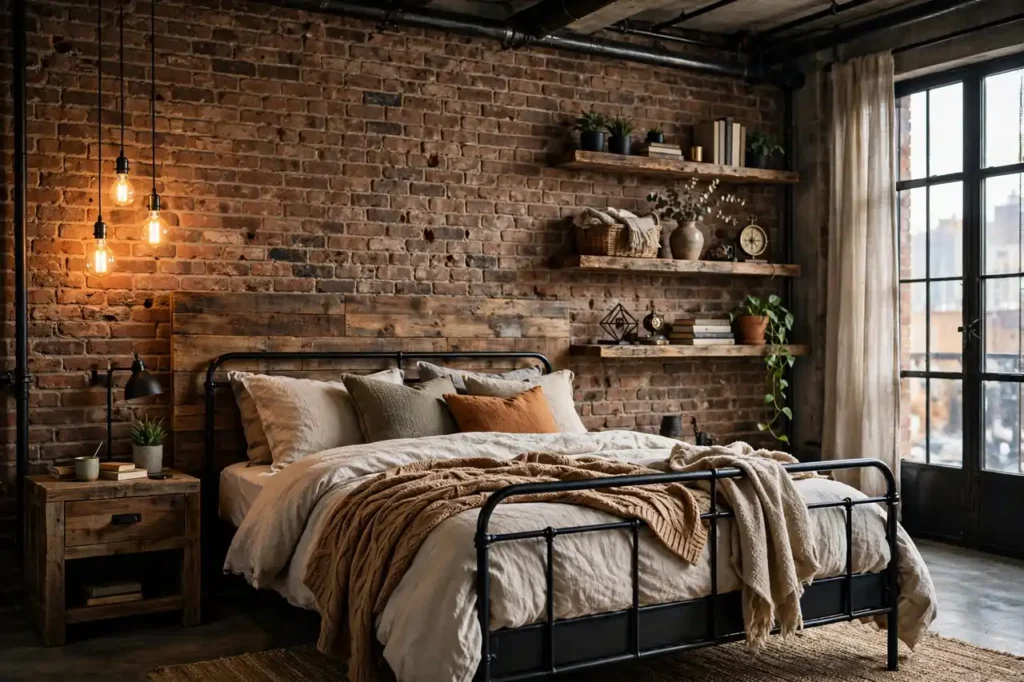
Industrial Bedroom Without a Brick Wall: Faux Finishes and Rental-Friendly Routes
No brick wall is no problem. Guides offer several routes that give the industrial look without a remodel. Faux brick panels and concrete look finishes give the texture on a flat wall. A black metal bed frame with pipe shelving or a pipe clothing rack gives the workshop feel through furniture alone.
Peel and stick wallpaper in a brick or concrete pattern is the rental friendly version, and it comes off without damage. Board and batten with thin boards gives a panelled industrial edge for little work. A matte charcoal or navy accent wall in a flat finish can stand in for brick when paired with black metal and warm wood. The key is restraint: one industrial gesture per room is enough. A brick look wall plus a black frame plus a leather chair is a system. Brick walls plus concrete floors plus steel everything is a warehouse, not a bedroom.
Modern Bedroom Dark: Moody Walls That Still Feel Restful
A modern bedroom dark scheme works when darkness is treated as a system, not a single wall colour. The mechanism is always the same: dark walls balanced by light bedding, light wood or light furniture, layered warm light, and texture. Corners recede in dark rooms, which is why guides describe dark small rooms as cocooning rather than cramped, provided the light and bedding do the balancing work.
Dark Japandi is a named system worth knowing. It pairs black, charcoal, or navy walls with a low platform bed in light upholstery, a floor to ceiling natural wood wardrobe, soft organic shaped lamps, and minimal greenery in dark pots. The light bed against the dark wall is the balance point, and matte or textured finishes keep it calm.
Which wall to paint dark matters. The headboard wall is the usual accent wall. The entry door wall is a useful alternative, because you do not face the darkest wall on entering, and it reads as low commitment. The largest wall suits bigger rooms. Whichever you choose, keep the ceiling light or white, use white woodwork to break up the dark colour, and let mirrors bounce light around the room. Two caveats belong here. Dark furniture is a different problem from dark walls: dark furniture needs light walls, while dark walls need light bedding and light elsewhere. A dark headboard wall also shortens how long a room feels, because the eye reads that plane as closer, so narrow rooms need the lightest dark option, or the entry wall instead, and every dark paint choice deserves sample testing across a full day. Our dark room colour guide covers how one dark wall and a hidden strip of light change each other.
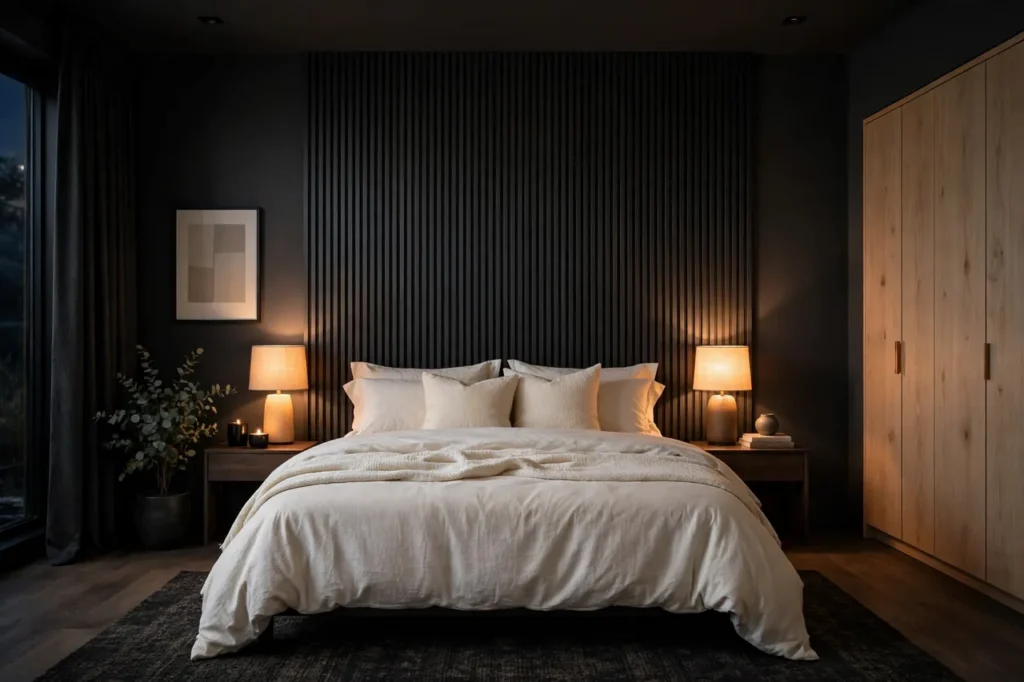
Layered Lighting for a Modern Bedroom: Ambient, Task, and Glow
Layered lighting is the most repeated fix in modern bedroom guidance, because one ceiling light alone creates harsh shadows and a flat mood. Three layers do the work: ambient light for the whole room, task light for reading and dressing, and glow, the low warm layer for evenings.
Ambient light usually means a ceiling fixture or recessed lights on a dimmer. Task light means bedside lamps or sconces at reading height. Glow means a low lamp, an LED strip behind the headboard, or a small accent light that stays on after the main lights go off. With dimmers on all three, one room shifts from bright morning to quiet night. Warm bulb temperature matters as much as brightness: guides advise matching warm temperatures across lamps rather than mixing styles and bulb temperatures, because mixed light reads restless. For strips and glow ideas, see our LED lights for bedroom guide.
Statement Lighting and Pendant Placement That Frees the Nightstand
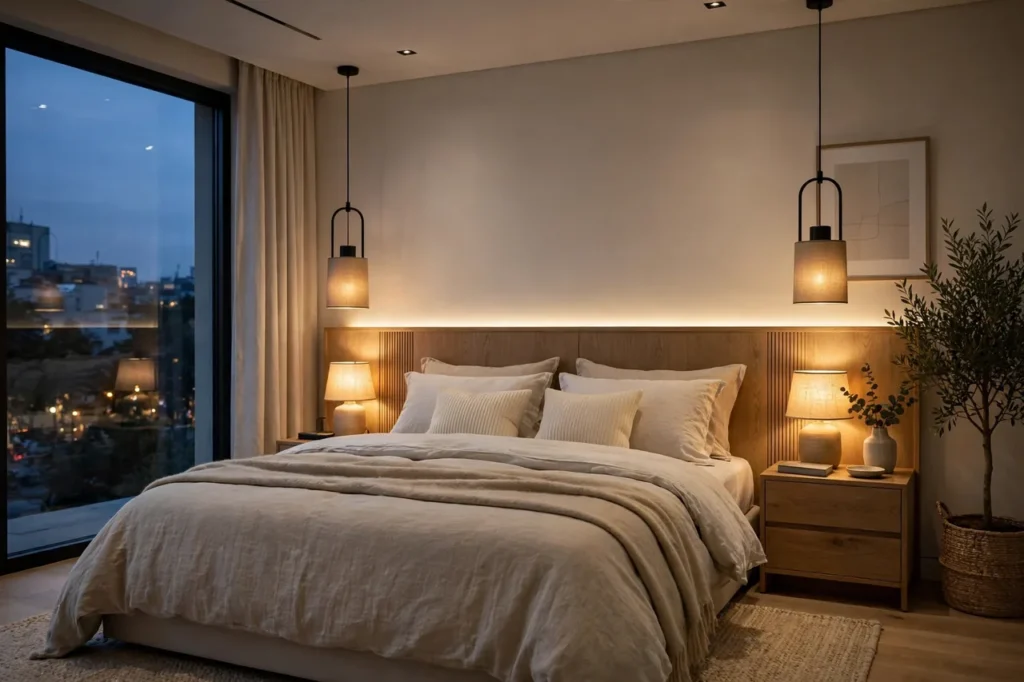
Statement lighting is the modern bedroom’s jewellery: one striking fixture that earns its place. A pendant hung beside the bed, a sculptural ceiling light, or a single bold lamp can carry a whole room, provided the rest of the lighting stays quiet.
Pendant placement has a practical payoff. A pendant hung at bedside height frees the whole nightstand surface, which is why guides praise it for small rooms and for a clear look. Under beams, pendant height rules change: the pendant must hang low enough to light the bed and high enough to clear heads, so measure the beam height before choosing. One statement piece is the rule, matching the art rule elsewhere in this guide. Pick one, keep the other lights simple and matching, and let the statement piece be the thing guests remember.
Storage That Stays Hidden: Floating Nightstands, Wardrobes, and Under-Bed Space
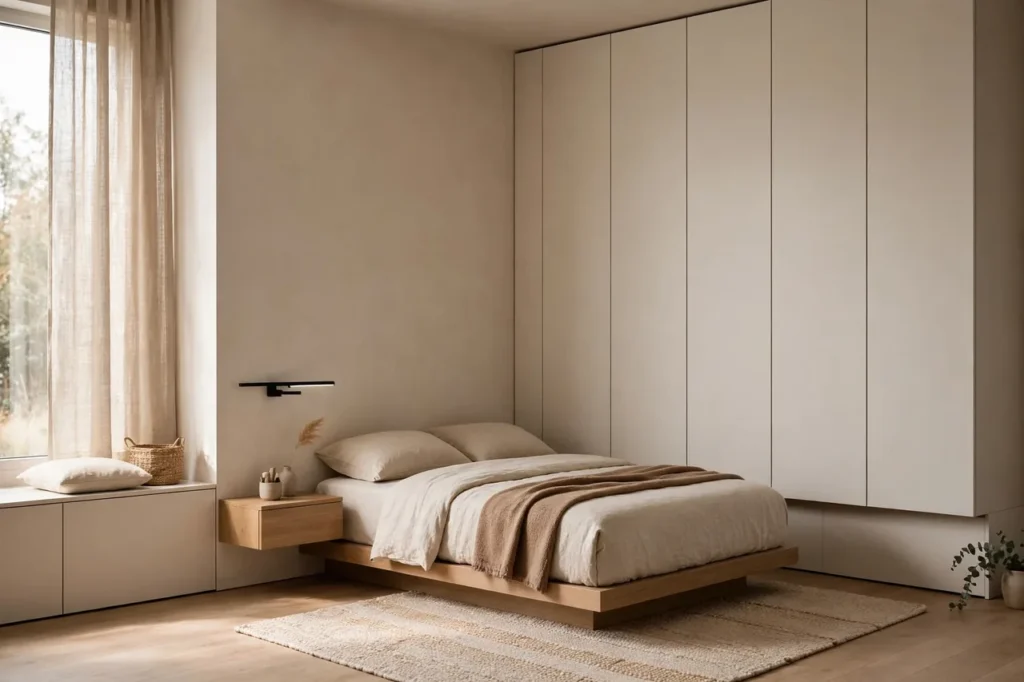
Hidden storage is what keeps a modern bedroom calm. The highest yield space is under the bed: a storage base or drawers hold spare bedding and out of season clothes without adding furniture. Floating nightstands give bedside storage without touching the floor, and they make cleaning easier.
Wardrobes should run to the ceiling where possible, because the gap above a short wardrobe collects dust and visual noise. Handleless doors and flat fronts keep the modern look, while inside, double rods and one long hang section organise clothes better than a single rail. For rooms with no closet, the open storage counterpart matters: a matte black ladder wardrobe, wall mounted rails with shelves, or a single open rail with matching hangers. Closed storage stays the rule for visual quiet, but one honest open zone, kept tidy, beats a cramped closet that never closes.
Bedding and Texture Layers: Linen, Wool, Boucle, and Velvet
Bedding is where a modern bedroom earns its comfort. Layer in this order: a fitted sheet, a duvet with some weight, a top layer for texture, and cushions kept to a few. Linen feels relaxed, wool feels warm, boucle feels plush, and velvet feels rich. Two or three of these in one bed give depth without colour noise.
Plants soften the layers, even in a minimal room. Trailing plants or low maintenance greenery add life against flat surfaces, and a single vase of stems on the nightstand is enough. Faux greenery suits rooms with little light, provided it looks good up close. Texture concentration is the rule applied to the bed: fewer, better textiles, each doing a clear job, rather than many thin layers that slide off. A chunky knit throw over a linen duvet, plus one velvet cushion, reads richer than five flat cushions in five colours.
Walls and Windows: Accent Walls, Panels, and Curtains That Keep It Modern
Walls do the most visible work in a modern bedroom, and the highest impact move is a feature wall. A half panel wall, French panelling, board and batten with thin boards, or vertical wood slats behind the bed all add structure without a new colour. Panel walls are also a popular budget project, because they change the room more than any single purchase.
Wallpaper is a modern finish too, especially peel and stick patterns in a subtle texture, which suit renters. A limewash accent wall gives soft, cloudy texture with paint alone, and it suits rooms that want warmth without pattern. Ceilings deserve the same thought, because guides call the ceiling the fifth wall. Painting the ceiling, limewashing it, or adding beams changes how the whole room feels, and it is often the final reveal in makeover stories. A ceiling one shade lighter than the walls keeps lift in a dark room, while a tray recess in a lighter tone adds shape without construction.
Curtains should hang high and wide: a rod close to the ceiling, extending past the frame, makes the window look larger. Floor length linen or cotton curtains soften sound and light, and sheer panels behind them give daytime privacy. One large statement art piece above the bed, rather than a gallery wall, keeps the modern restraint intact.
Modern Bedroom 2026: Organic Shapes, Curves, Cane, and Warm Minimalism
Modern bedroom 2026 directions, as guides describe them, are warmer and softer than the strict minimalism of earlier years. Organic shapes lead: curved headboards, rounded nightstands, and arched mirrors soften straight lines. Cane and rattan details add natural texture to beds, wardrobes, and pendants.
Japandi, the blend of Japanese minimalism and Scandinavian coziness, is repeatedly named as a defining current direction: low slung platforms in light woods, rounded upholstered headboards in boucle or natural linen, warm whites and soft beiges, clay and muted olive accents, and texture doing the work through linen bedding, handmade ceramics, and wool rugs. Warm minimalism ties it together: fewer objects, but warmer materials and softer shapes. Floating beds and quiet technology, such as hidden charging and dimmers rather than visible gadgets, keep the look clean. Treat 2026 directions as options, not rules. A room built on warm neutrals and good texture will still feel current when the next direction arrives.
Mixing Wood Tones and Metals Without Clutter
Mixing wood tones and metals is where many modern bedrooms go wrong, and the fix is a finish limit. Guides advise one or two finishes, not four: one dominant wood and one metal, with a second wood only as a small accent. Named woods that suit modern bedrooms are natural oak, walnut, teak, and ash. Light wood reads fresh and airy, darker walnut adds warmth and sophistication, and a matte finish suits contemporary rooms because it shows the grain.
Metals follow the same rule. Brushed silver, champagne brass, oil rubbed nickel, chrome, and pewter all appear in modern guidance, but a room should carry one or two at most. Black metal is the exception that pairs with almost anything, which is why it anchors industrial rooms so well. Tie the mix together by repeating each finish in at least two places: walnut on the frame and the nightstand, brass on the lamp and the tray. A finish that appears once looks like a mistake. A finish that appears twice looks like a decision.
Mistakes That Break a Modern Bedroom
A few mistakes break modern bedrooms more than any other. Overfilling is first: every surface covered, every wall hung, no open space left. Modern rooms need empty space the way other styles need decoration.
Harsh lighting is second: one ceiling light doing every job, mixed bulb temperatures, and no warm evening layer. Saturated colour across large surfaces is third, because a bold colour on every wall reads loud rather than modern. All flat finishes are fourth: a room with no sheen variation reads one note, so mix matte and a little sheen. Undersized rugs, mismatched nightstand heights, and too many small decorative objects round out the list. So does buying furniture before measuring, and mixing too many styles at once. One loud surface is the most a modern room can carry: a striped headboard or a bold art piece, with calm bedding to balance it.
Modern Bedroom FAQs
What is the difference between modern, contemporary, and transitional bedrooms?
Modern is a fixed style of clean lines and minimal ornament. Contemporary changes with current trends and mixes materials more freely. Transitional blends modern and traditional, with clean soft lines and neutral walls.
How do I keep a modern bedroom from feeling cold or sterile?
Add warmth through texture and light: linen and wool bedding, a woven rug, timber tones, and warm dimmable lamps. Keep one warm undertone in the walls rather than stark white.
Can I paint a small bedroom dark without it feeling smaller?
Yes, with balance: paint one wall only, keep the ceiling light, use light bedding, and layer warm light. The entry door wall is a good low commitment choice, because you do not face the darkest wall on entering.
Which wall should I paint dark in a bedroom?
The headboard wall is the usual choice. The largest wall suits bigger rooms, and the entry door wall suits small or narrow rooms. Test samples across a full day before committing.
Should I buy a matching bedroom set or mix pieces?
A set is easier and suits a first home or guest room. Mixed pieces feel more personal if you hold one common element, such as height, colour, or material, and anchor symmetry with identical lamps and consistent nightstand heights.
How do I make mismatched nightstands look intentional?
Match their height and one other element, such as lamp style or finish. Keep the bedding and wall colour calm so the nightstands read as a pair rather than a clash.
What wood finishes work best in a modern bedroom?
Natural oak, walnut, teak, and ash suit modern rooms. Light wood reads fresh, walnut adds warmth, and a matte finish shows the grain and suits contemporary rooms.
How do I get an industrial look without a brick wall?
Use faux brick panels, concrete look finishes, or peel and stick brick wallpaper, plus a black metal bed frame and pipe shelving. One industrial gesture per room is enough.
What is dark Japandi, and does it work in a bedroom?
Dark Japandi pairs black, charcoal, or navy walls with a low light upholstered bed, natural wood, and soft lighting. It works well because the light bed balances the dark walls.
How do I make a modern bedroom feel luxurious on a small budget?
Focus on feel, not purchases: a plush rug by the bed, crisp bedding, a decluttered dresser, warm dimmable light, and one textured throw. One or two quality textiles beat many decorative objects.
Final Thoughts: A Modern Room That Still Feels Like Home
A modern bedroom works when clean lines meet warm materials. Start with a low bed, pick one neutral system, add texture instead of ornament, and layer the light. Let one statement piece speak, keep storage hidden, and leave open space for the room to breathe.
Then live in it before adding more. A modern room that feels calm on ordinary mornings, for sleeping, waking, and winding down, beats a room that only photographs well.
Get home ideas in your inbox
Practical home improvement ideas and DIY guides, once in a while. No spam.



One Comment
Comments are closed.