Industrial Kitchen Ideas: Raw Materials, Bold Fixtures, and Spaces That Work Hard
An industrial kitchen looks like it means business. It borrows its language from factories and warehouses: raw brick, exposed steel, concrete surfaces, and appliances built like professional equipment. Nothing is hidden behind decoration, and nothing is fussy. This guide covers the whole job: the layout, the materials, the shortcuts that give you the look without the upkeep, the lighting, the shelving, and the two styles that sit closest to industrial, colonial kitchens and vintage decor.
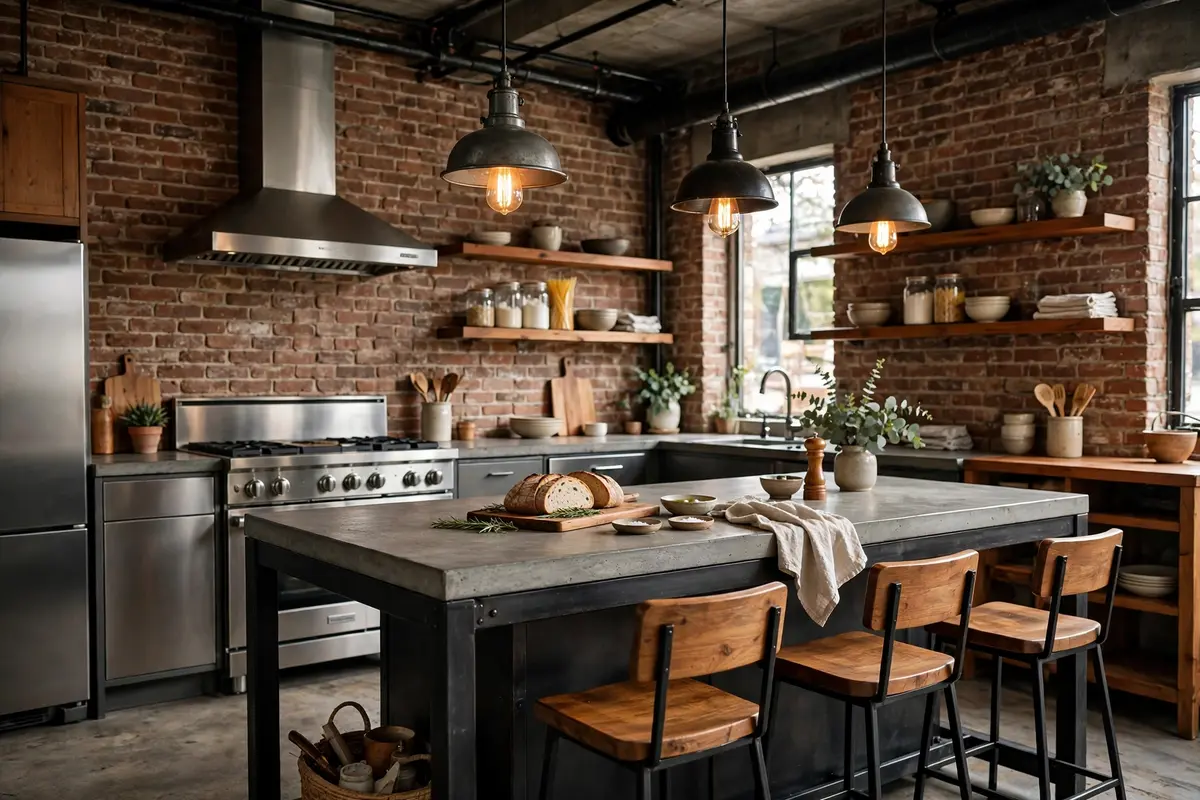
The industrial kitchen ideas in this guide all work from the same kit of parts: raw brick, exposed steel, concrete surfaces and statement lighting.
What an Industrial Kitchen Actually Looks Like
Picture a room with a high ceiling, a large island, and surfaces you can wipe clean in seconds. Exposed brick walls, wooden rafters, and metal frame windows set the tone. Straight lines and solid colours replace intricate patterns. Appliances and faucets look rugged, even overbuilt, which is part of the appeal: the kitchen feels monumental, like a place built to work hard for decades.
It is a common worry that this sounds cold. Done badly, it is. Done well, it is not, because the rawness is balanced with warmth: wood tones, warm lighting, plants, and one or two soft textures. The industrial look is not about making a kitchen feel like a factory floor. It is about keeping the honest materials of a factory and removing the noise, the clutter, and the grime.
Open Space and High Ceilings: The Industrial Layout
An authentic industrial kitchen starts with space. Open floor plans and abundant workspace are crucial, because the style comes from buildings where rooms were large and work happened in the open. A central island and ample counter space for preparation and appliances are the core of the layout, not an optional extra.
High ceilings help enormously. Soaring or vaulted ceilings create a sense of openness, give room for tall cabinets, and improve ventilation, which matters in a hard-working kitchen. If your ceiling is standard height, you can still get the feeling: keep upper cabinets minimal or open, run shelving high, and avoid breaking the room with a soffit or a low hanging feature that is not a light.
Open does not mean empty. It means clear paths, a visible work triangle, and surfaces that stay usable instead of filling with appliances you rarely touch. Store what you do not use daily elsewhere, and the industrial openness takes care of itself.
Exposed Bones: Brick, Beams, Ductwork, and Metal Frames
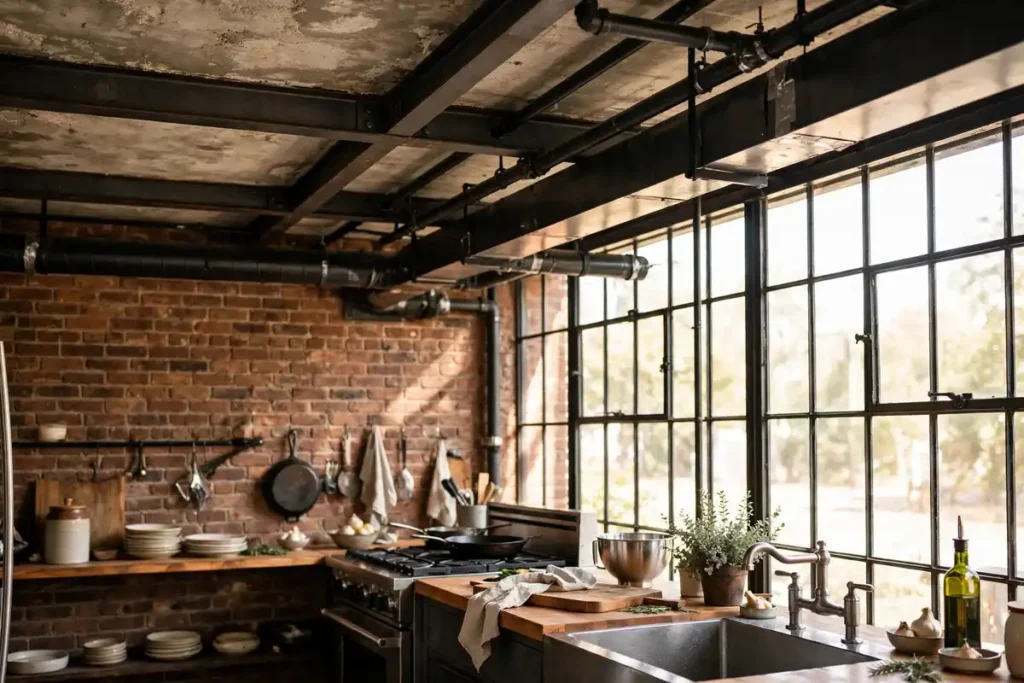
The most recognisable industrial detail is the building itself, left visible. Old manufacturing spaces have architectural elements that are now desirable design features: exposed ductwork, concrete beams and columns, and metal frame windows. In a home kitchen, you recreate that honesty rather than faking it.
Exposed brick is the anchor. A single brick wall, left unpainted, gives the whole room its character, and it pairs with almost every industrial material. Concrete beams or columns do the same in a more modern shell. Visible ductwork, painted black or left in galvanised steel, turns a ceiling problem into a feature, and it is one of the cheapest industrial details, because it is often already there above a dropped ceiling.
Metal frame windows, in black steel, complete the look, especially in loft-style kitchens where the window grid repeats the lines of the shelving and the island frame. If your windows are standard, black hardware and dark frames on nearby glass doors can echo the same lines without replacing a window.
Materials That Carry the Look: Concrete, Steel, and Stone
Three materials do most of the work in an industrial kitchen. Concrete brings a matte, heavy, architectural quality to floors, counters, and even islands. Steel brings shine and precision: stainless steel appliances, sinks, taps, and shelving. Stone brings natural variation: granite, soapstone, and marble-look surfaces that stop the room feeling like a laboratory.
Each has a honest weakness, and knowing it saves money later. Concrete is porous and stains if unsealed. Wood is affected by water and heat. Brick walls need maintenance as they wear. A good industrial kitchen does not pretend these problems away. It seals concrete, keeps wood away from direct hob heat, and accepts that brick will age, which is part of its charm.
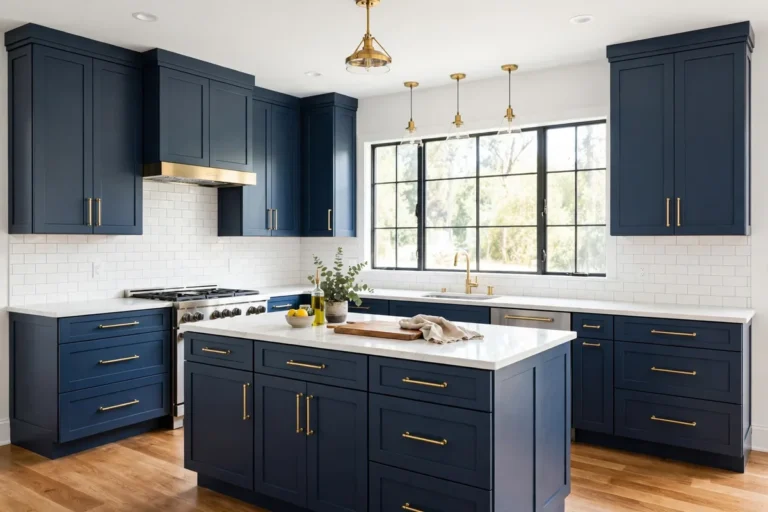
The palette stays disciplined: greys, blacks, whites, and one warm wood tone. Multiple bright colours or busy patterns clash with the industrial aesthetic, which depends on restraint. One bold accent, like a navy cabinet run or a copper backsplash, works precisely because everything around it stays quiet.
The Porcelain Shortcut: Concrete, Stone, and Metal Looks Without the Upkeep
If real concrete, stone, and metal sound like too much maintenance, porcelain tiles and slabs are the practical shortcut designers now use. Large format porcelain captures the industrial spirit without the functional compromises: wood-look tiles give you timber warmth with moisture resistance, concrete-look slabs give you the matte industrial surface with far greater durability, and stone-look slabs give you marble or soapstone character that resists stains and scratches.
The three looks each suit a different room. The concrete look, in beige, brown, or tarmac tones, gives a minimalist edge and suits handleless kitchens. The stone look adds natural character, with soapstone and mineral grey among the most convincing palettes for a contemporary industrial kitchen. The metal look, in light grey or grey stone hues, matches metal taps, hobs, chairs with metal legs, and cabinet handles into one sleek, high-performance scheme.
Porcelain also solves the backsplash and cladding problem in one material. The same slab on the counter, the backsplash, and the wall cladding unifies the room, and it is easy to clean, which matters more in a hard-working kitchen than any single visual trick.
Cabinets: Simple, Clean, and Open
Cabinetry in an industrial kitchen follows one rule: clean lines and simplicity. Flat-panel doors, neutral colours like natural wood, white, or black, and hardware that is functional without standing out. Open cabinets, full or partial, are favoured for their open and minimalist feel, and they suit the style because they display the kitchen’s working tools instead of hiding them.
Handle choice matters more than people expect. Slim bars in black or stainless steel keep the lines clean. Knobs in a matching metal finish do the same on smaller doors. Avoid ornate handles, curved profiles, and mixed finishes, because each one adds a visual detail the industrial look does not want.
If full open shelving feels too exposed, the compromise is a mix: closed base cabinets for the clutter, open uppers or a single open run for daily dishes and glassware. That keeps the industrial openness where you see it and the storage where you need it.
Countertops and Islands: The Hard-Working Centre
The countertop is where industrial design proves itself, because it must survive daily work and still look deliberate. Stone, granite, concrete, and quartz are the standard choices, and the right one depends on how you cook. Granite is hard and heat resistant. Concrete is matte and architectural but needs sealing. Quartz is nonporous, so it resists staining, scratching, cracking, and heat, which is why it suits industrial kitchens that must look rugged and stay practical.
The island is the centre of the room and the best place to spend. A kitchen island enhances the visual interest of an industrial kitchen and gives it a focal point. Marble-look slabs and grey concrete-look countertops both work, and a waterfall edge, where the counter material runs down the side of the island, makes the island read as one solid block. For a wood-based island in the same spirit, see our guide to rustic kitchen island, which covers reclaimed wood, storage, and seating that pair well with industrial materials.
Size the island for work first. It should hold prep space, a sink or hob if you want one, and seating on one side, without blocking the paths around it. An island that is too big for its walkways breaks the open feeling the whole style depends on.
Backsplashes and Wall Cladding: Easy to Clean, Big on Impact
Backsplashes do quiet work in an industrial kitchen: they protect the wall and they set the tone. Black, marble-look, and stone-look backsplashes all enhance the industrial style, and they are easy to clean, which is a genuine advantage behind a hob. Matching the backsplash to a wraparound island in the same material and colour tones makes the room feel designed rather than assembled.
Wall cladding takes the same idea further. Cladding a wall in the same material as the countertops and backsplash truly unifies the look, and black porcelain slabs in particular add sophistication to an industrial kitchen. A full clad wall suits a modern scheme. A partial clad wall, behind the hob and sink only, gives you most of the effect at lower cost.
Brick is the alternative cladding, and it is the warmer one. An exposed brick backsplash or a brick feature wall brings texture that porcelain cannot, and it pairs beautifully with stainless steel. Seal brick behind a hob, because grease and steam mark unsealed brick faster than any other surface in the room.
Stainless Steel Appliances: The Professional Core
Stainless steel is the staple of industrial kitchen design, favoured for its sleek and modern look. It fits seamlessly because it is the material professional kitchens actually use. Classic or contemporary appliances both work, and mixing stainless finishes, brushed with polished, adds depth without breaking the palette.
Industrial kitchens are often designed to serve more people, so capacity matters. A double oven, an extra-large fridge, and a hob with room for large pans all suit the style and the way these kitchens are used. Smaller upgrades help too: a microwave with convection options, a mounted espresso machine, or a hideaway toaster add function while keeping the look simple.
The rule is the same as for cabinets: keep appliances visually quiet. One statement piece, like a large range or a professional hood, is enough. A wall of competing chrome, black glass, and coloured enamel stops reading as industrial and starts reading as a showroom.
Lighting: Domed Pendants, Metal Cones, and Statement Fixtures
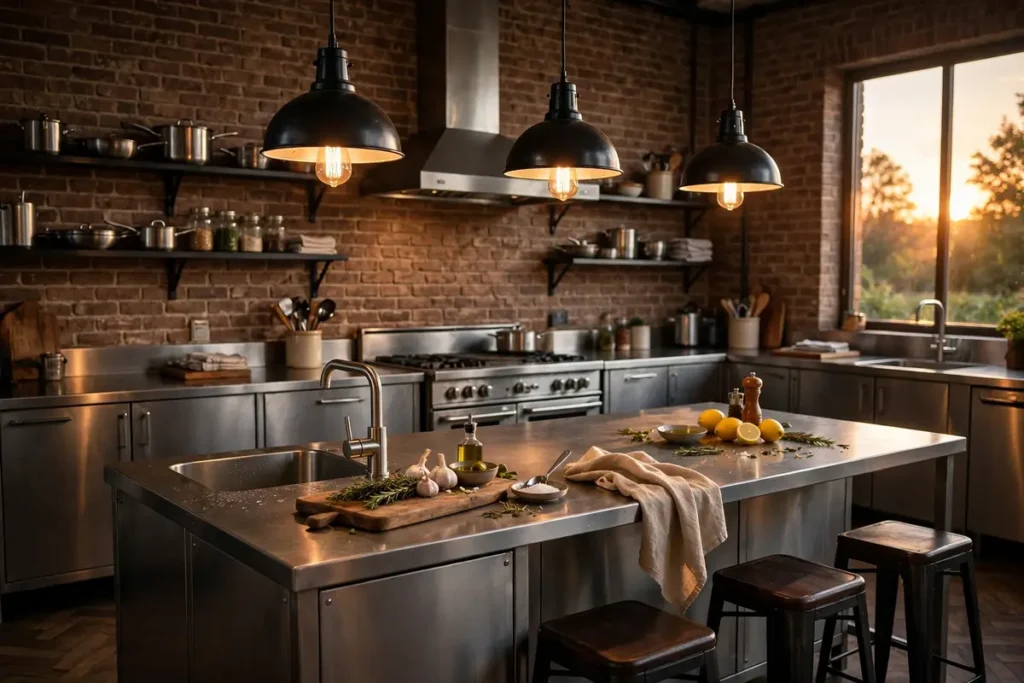
Lighting is where industrial kitchens make their boldest statement, and the fixtures are deliberately visible. Domed pendant lights suit modern and contemporary kitchens. Steampunk-style fixtures, with exposed bulbs, cages, and mechanical details, suit traditional and vintage-leaning spaces. Metal cone lights, hung low over an island, are the most recognisable industrial fixture of all.
The practical advice is simple: avoid recessed lighting as your main feature, because it does not make a statement, and industrial style rewards bold fixtures. Use in-ceiling cans or LEDs for general light if you need them, but let the pendants carry the look. Warm bulbs matter, because cool white light makes concrete and steel feel clinical. Natural materials soften the palette too: woven light covers over a metal fixture warm a room that would otherwise feel hard.
Hang pendants over the island and the sink, not over walkways, and hang them low enough to light the work without blocking sightlines. Two or three pendants suit most islands. One oversized dome suits a small kitchen better than a row of small ones.
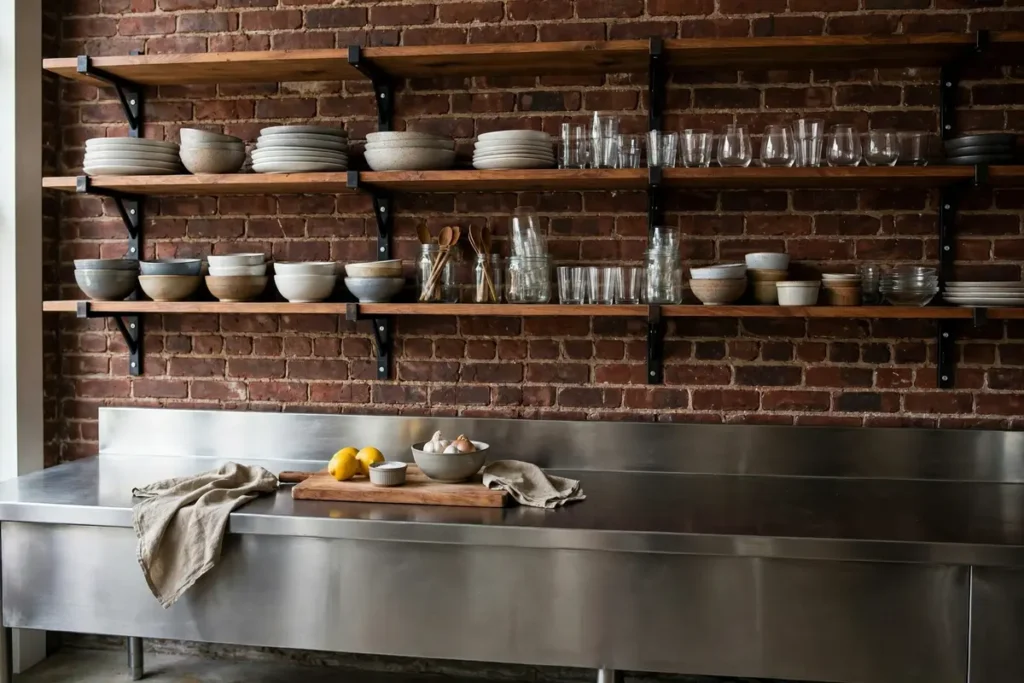
Open Shelving: Warehouse Style on Your Walls
Open shelving taps directly into the warehouse look, and it is one of the easiest industrial details to add. Standing metal shop shelving, bought from a home hardware store, adds instant industrial charm and holds bulk food and decor. If the room is not large enough for standing shelves, wall-mounted open shelving made from planks and wood-and-metal brackets gives you the same effect, and pre-made versions are widely available.
The material choice should follow the room. Porcelain shelves in the same colour as the countertops and walls create a sleek profile. Wood shelves add warmth, but keep them away from ovens and hobs, because wood is affected by moisture and heat. Metal brackets and rails in black or galvanised steel tie the shelves to the rest of the room’s hardware.
Style open shelves the way a warehouse would: groups of daily items, not a display. Plates, bowls, glassware, and a few cookbooks, with breathing space between groups, look industrial. Shelves packed edge to edge with decoration look like a shop, not a kitchen.
Flooring That Lasts: Concrete, Tile, and Wood Looks
Flooring in an industrial kitchen must survive years of wear, and longevity is the first consideration. Concrete floors are the most honest choice: matte, hard, and perfectly in keeping with the style, though they are unforgiving underfoot and need rugs in standing spots. Large format tiles are the practical alternative, especially wood-look tiles, which give you timber warmth with tile durability.
Wood itself is not typically used for industrial flooring, but it works as a contrasting element: a wood island, wood shelving, or a wood table against a concrete or tile floor adds depth and character. Wide-plank wood flooring also softens a room that would otherwise feel entirely hard, and it pairs well with brick walls and black metal.
Whatever the floor, keep it in the same muted family as the rest of the room. A strongly patterned or bright floor fights the industrial palette, while a quiet floor lets the island, the shelving, and the lighting carry the room.
Colour Palette: Grey, Black, and Warm Wood
The industrial palette is mostly grey, and that is a strength, not a limitation. Grey covers concrete, steel, stone, and shadow, and it lets one warm material, usually wood, do all the emotional work. Black adds definition: window frames, hardware, faucet, pendant shades, and the legs of stools. White lifts the room: walls, uppers, or a marble-look top that stops the grey turning gloomy.
Warm wood is the material that keeps grey from feeling cold. Natural oak, walnut, or reclaimed timber on an island, a shelf, or a table introduces the only organic colour the room needs. Darker woods add richness. Lighter woods keep the room bright. Either works, but mixing three or four wood tones in one room breaks the discipline, so pick one and repeat it.
One accent colour is allowed, and it should be used sparingly. Navy cabinetry, a copper backsplash, or a deep green island wall all work, precisely because they are the only strong colour in the room. Two strong colours compete. One strong colour defines.
Modern Industrial Kitchens: Minimal, Streamlined, and Warm
Modern industrial is the most popular variant of the style, and its rule is simplicity. Quartz countertops with a textured finish, like a raw concrete look, are very popular, because they give you the industrial surface without the sealing and staining worries of real concrete. Minimalist pendant fixtures, open wood shelving, and streamlined metal or wooden stools complete the look.
The risk in modern industrial is coldness. Modern design lacks some of the warmth of vintage looks, so the room needs deliberate warming: potted plants, warm lighting, darker woods, and subtle hints of neutral colours. A plant on the windowsill, a wooden board left out, and warm bulbs in the pendants are enough. The room should feel calm and clean, not empty.
Keep accessories minimal and let the materials do the work. One wood tone, one metal finish, one counter material, and nothing extra competing for attention. That restraint is what makes a modern industrial kitchen feel expensive rather than bare.
Urban Industrial Kitchens: Small Spaces, Big Style
Urban and industrial styles overlap heavily, but urban kitchens face one constraint industrial design usually does not: small space. In a city kitchen, space comes at a premium, and the openness of industrial design has to be achieved through palette and materials rather than sheer size.
A galley layout is the most reliable solution. It keeps the work triangle tight and lets you apply industrial details where they fit: a dark metal faucet, a concrete-look counter, open shelving on one wall, and a lighter colour palette that keeps the narrow room bright. Large patterned tiles help too, because a big pattern in a small room reads as intentional, while small busy tiles read as clutter.
Keep the room as uncluttered as possible. Store items you do not use daily in a separate room or a tall pantry, and free the countertops for daily work. Urban industrial features that fit small rooms include slotted drawers, built-in shelving, eat-in areas at a counter end, and mirrored backsplashes, which bounce light and make a narrow kitchen feel wider.
Colonial Kitchen: Traditional Roots in an Industrial Frame
Colonial is the secondary keyword, and it deserves its own section, because it shows how far industrial style can stretch. A colonial kitchen comes from early American homes: raised-panel wood cabinets, a large hearth or range, natural timber, and a warm, crafted feeling. Put that inside an industrial frame, exposed brick, black metal, concrete surfaces, and the two styles meet in the middle: traditional warmth with industrial honesty.
The combination works because both styles value real materials and visible construction. A colonial cabinet door in natural wood sits naturally beside a brick wall and a steel faucet. A farmhouse sink, a timber mantel over the range, and a wooden table instead of an island all read as colonial, while the steel, concrete, and open shelving around them read as industrial.
The balance to watch is ornament. Colonial style can carry moulding, panelling, and decorative hardware that industrial style rejects. Keep the colonial details to the cabinetry and the timber work, and keep the industrial details to the metal, the surfaces, and the lighting. If both styles try to decorate the same surface, the room feels confused. If each owns its own surfaces, the room feels layered and intentional.
Vintage Kitchen Decor: Tins, Clocks, and Steampunk Touches
Vintage decor is the second secondary keyword, and it is how an industrial kitchen gains personality without losing its edge. The style already leans vintage: exposed brick, wooden rafters, and old factory details are themselves vintage elements. Decor simply makes that history visible on the shelves and walls.
Open shelving is where vintage decor lives. Old tobacco tins, clocks, metal sculptures, enamel signs, and mechanical drawings all make great artwork in an industrial kitchen, especially when they are genuinely old rather than reproduction. Steampunk-style decor, with gears, gauges, and mechanical drawings, is the current trend in industrial kitchen art, and it suits the style because it celebrates machinery instead of hiding it.
The rule is curation, not collection. Three or four vintage pieces, spaced out and given room, read as a designed kitchen with history. Twenty pieces crowded onto every shelf read as a shop. Rotate pieces seasonally if you collect more than the room can hold, and keep the working shelves, plates, bowls, and glassware, separate from the display shelves, so daily cooking never has to move a vintage clock to reach a plate.
Softening the Edge: Plants, Wood, and Warm Light
Every industrial kitchen needs softening, and it takes less than people expect. Plants are the fastest fix: a trailing plant on open shelving, herbs on the windowsill, and one larger pot by the door introduce living green against grey and steel. Wood is the second fix: a board, a bowl, or a stool in warm timber breaks up hard surfaces. Warm light is the third: warm bulbs in pendants and under-cabinet strips turn concrete from cold to calm.
Textiles do quiet work too. Linen towels, a washable rug by the sink, and a cushion on an eat-in bench all soften a room that is otherwise metal, stone, and glass. Keep textiles in muted tones that match the palette, because a bright patterned textile fights the industrial discipline the same way a bright wall does.
The test is simple: stand in the room at night with only the pendants on. If it feels like a workshop, add wood and warm light. If it feels like a home that happens to have steel and brick, the balance is right.
Industrial Kitchen Mistakes to Avoid
The first mistake is copying a factory instead of a kitchen: too much raw concrete, too much black metal, and no warm material to rest the eye on. The second is the opposite: so many soft, decorative touches that the industrial character disappears under cushions, curtains, and patterned tiles.
The third is material dishonesty: printed concrete-look laminate on every surface, fake brick wallpaper, and plastic steel-look handles. One convincing lookalike, like porcelain, is smart. A room full of fakes reads as a theme restaurant. The fourth is lighting failure: recessed cans only, which flatten the room and waste the style’s best feature, its fixtures.
The fifth is storage theatre: open shelves styled for photographs with nothing you actually cook with, while daily pans live in a distant cupboard. Open shelves should hold what you use. The sixth is ignoring upkeep: unsealed concrete that stains in a month, unsealed brick behind a hob that greases over, and wood shelves hung beside an oven that warps. Industrial materials are honest, but they are not maintenance-free.
Industrial Kitchen on a Budget: Shelving, Paint, and Smart Swaps
Industrial is a forgiving style on a budget, because its best details are cheap. Metal shop shelving from a hardware store is the single highest-impact swap: it adds instant industrial character and useful storage for very little money. Plank and bracket wall shelves are the next cheapest, and pre-made versions are widely available.
Paint is the second budget tool. Black paint on window frames, hardware, and a pendant shade transforms a room without replacing anything. A concrete-look paint or a large format tile on one wall gives you the industrial surface at a fraction of a real concrete slab. Keep the expensive material for one hero surface, like the island top, and use lookalikes everywhere else.
Spend where you touch daily: the faucet, the handles, the stools, and the lighting. Save where it does not show: the carcass, the inside of cabinets, and the floor under the island. A good faucet and good pendants make a budget kitchen feel industrial. The reverse is never true.
Outdoor Industrial Kitchens: Materials That Survive Outside
An industrial outdoor kitchen is a natural extension of the style, because the materials already suit the outdoors: steel, concrete, stone, and brick. The rule is to choose materials for weather, not just looks. Porcelain shelves and slabs are a better outdoor choice than wood, because they do not need the high maintenance wood demands outside. Stainless steel appliances and sinks handle rain and heat. Concrete and stone counters survive both.
Cover what you can. A roof or pergola over the cooking zone protects appliances and keeps the kitchen usable in rain. Drainage matters more outdoors than in: a concrete floor should slope slightly away from the house, and a sink needs a proper drain, not a bucket. Lighting should be weather-rated, and metal cone pendants in galvanised steel suit an outdoor industrial kitchen better than painted fixtures that will peel.
Keep the layout simple outdoors: a grill, a prep counter, a sink, and storage, in one straight run or an L. An outdoor kitchen that tries to replicate a full indoor kitchen usually ends up half-used. A compact, well-built outdoor station gets used every week.
FAQs
What is an industrial kitchen?
An industrial kitchen combines rugged materials and appliances with a primarily grey colour palette, reminiscent of industrial spaces like factories and warehouses. In homes it is adapted for its timelessness and rustic charm, with exposed brick, steel, concrete, and open layouts.
How do you design kitchen ceiling lights in the industrial style?
Use domed pendant or steampunk-style fixtures. Domed pendants suit modern kitchens, steampunk fixtures suit traditional spaces. Avoid recessed lighting as the main feature, because bolder fixtures are more in keeping with the industrial style. Warm bulbs keep steel and concrete from feeling cold.
How do you make industrial-style shelves for a kitchen?
Standing metal shop shelving from a hardware store adds instant industrial charm and holds bulk food and decor. For smaller rooms, build wall-mounted open shelving from planks and wood-and-metal brackets, or buy pre-made versions. Keep wood shelves away from ovens and hobs.
Can an industrial kitchen work in a small space?
Yes. Use a galley layout, a lighter colour palette, large patterned tiles, and uncluttered counters. Apply industrial details where they fit, like a metal faucet, a concrete-look counter, and open shelving on one wall, rather than trying to recreate a loft.
Is concrete a good kitchen countertop material?
Concrete looks architectural and handles heat well, but it is porous and stains if unsealed. Seal it properly and maintain the seal, or use a concrete-look porcelain slab for the same appearance with far less upkeep.
How do I stop an industrial kitchen feeling cold?
Add warm wood, plants, warm lighting, and one soft textile, like linen towels or a washable rug. Keep the palette grey and black, but let one warm material, usually wood, do the emotional work in the room.
What is the difference between industrial and colonial kitchen style?
Colonial style comes from early American homes: raised-panel wood cabinets, natural timber, and a crafted, warm feeling. Industrial style comes from factories: steel, concrete, brick, and visible construction. They combine well when colonial owns the cabinetry and timber, and industrial owns the metal, surfaces, and lighting.
Can I mix vintage decor into an industrial kitchen?
Yes, and it suits the style, because industrial design already leans vintage. Display a few genuine vintage pieces, like old tins, clocks, or metal sculptures, on open shelving, with breathing space between them. Keep working shelves separate from display shelves.
What appliances suit an industrial kitchen?
Stainless steel appliances are the core, with a large range or professional hood as the statement piece. Double ovens, extra-large fridges, and high-capacity hobs suit the style, while small upgrades like a mounted espresso machine add function without clutter.
How do I maintain brick and steel in an industrial kitchen?
Seal brick behind a hob, because grease and steam mark it quickly. Wipe stainless steel with the grain to avoid streaks, and dry it after cleaning. Accept that brick and steel age: patina on both materials suits industrial kitchens better than a perfect finish.
Get home ideas in your inbox
Practical home improvement ideas and DIY guides, once in a while. No spam.