Mid Century Kitchen Ideas: Warm Wood, Clean Lines, and Retro Details That Still Work
Step into a mid century kitchen and you feel it at once: warmth, clarity, and a sense that everything has a reason to be there. Clean lines, natural wood, and retro details that never feel outdated. The style comes from the 1950s and 60s, when American homes embraced open living, honest materials, and furniture designed for real life. This guide covers the whole job, from cabinets to a remodel plan that works on any budget.
What a Mid Century Kitchen Actually Looks Like
A mid century modern kitchen, often shortened to MCM, is defined by a few clear traits. Flat-panel cabinets instead of raised panels. Warm wood finishes like walnut or teak. Geometric or organic accents. Minimal hardware. Function and form working together, with nothing ornamental for its own sake.
Unlike traditional kitchens that rely on ornamentation, MCM design keeps decoration quiet and lets materials speak. Natural wood grain, a speckled terrazzo surface, a brass faucet, and a globe pendant do more than a wall of moulding ever could. The room feels calm because every element is simple, and warm because the main material is wood. The style has lasted because it is practical, not just pretty: open plans suit modern living, flat doors are easy to clean, warm wood ages gracefully.
Appliances are part of the look, not an afterthought. The classic mid century kitchen ran on built-ins: a wall oven with a separate cooktop, a top-freezer refrigerator, and a chrome dinette set under a sputnik light. Colours did the talking: pastel pink, turquoise, butter yellow, and mint green on ranges and counters, with avocado green and coppertone arriving in the 1960s. Originals were built to last, and some still run after sixty years, which is why working vintage appliances are prized in restorations. If originals are out of reach, colourful retro-styled appliances give the same effect without the repair risk, and an appliance garage keeps small modern appliances hidden so counters stay clear.
Flat-Panel Cabinets: Walnut, Teak, and Warm Wood
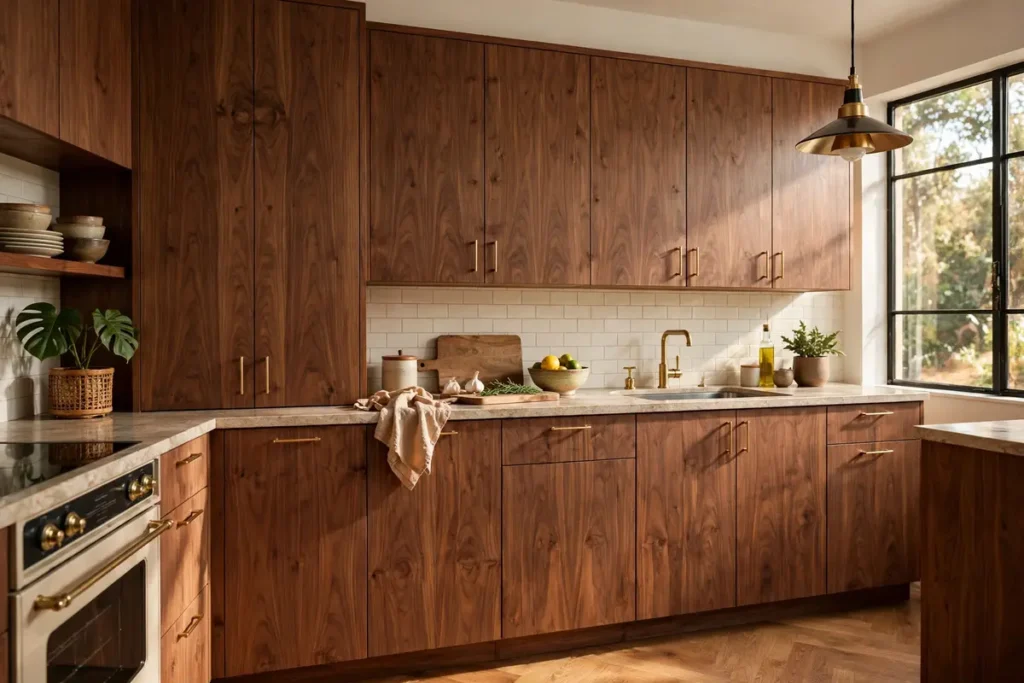
Cabinets are the first thing to get right, because they cover the most wall. Flat-panel, or slab, doors are the MCM signature: no raised panels, no bevels, no fuss. The door is a flat plane of wood, and the grain is the decoration. Walnut is the classic choice, with its deep brown tone and rich grain. Teak is warmer and slightly golden. Oak and elm veneers are lighter alternatives that suit smaller or darker rooms. Quarter-sawn oak, with its straight, even grain, is another period-correct choice for slab doors.
Below-the-counter wooden storage looks better than over-the-counter storage in an MCM kitchen, because it keeps the wall line clean and the room feeling open. Hardware should be minimal: slim tab pulls, small knobs, or integrated pulls that barely show. Brass pulls warm a walnut kitchen beautifully, black pulls suit a cooler palette, and consistency matters most: one finish, one style, repeated across the room, so the cabinets read as one calm surface. Before ordering, answer five questions in order: construction type, cabinet box type, door type, door style, and material. Door style has only one right answer in this style: slab, every time. Material is the flexible choice: solid wood, veneer, or painted finishes all work, and the earliest mid century kitchens even used enameled steel cabinets. If your boxes are plywood, level, and undamaged, refacing with new slab doors and hardware gives most of the result for a fraction of replacement cost.
Open and Floating Layouts: Space Without Walls
Mid century design is obsessed with space, and the kitchen layout is where that obsession pays off. An open kitchen has no barriers separating it from the dining or living area, which increases the usable area and removes the stuffiness that boundary walls create.
A floating kitchen goes further: transparent walls, usually glass, between the kitchen and a garden or landscape, so the kitchen feels like part of the environment. Floor-to-ceiling windows do the same job more simply, drawing the outdoors in and expanding the sense of space. Vaulted ceilings and high clerestory windows suit the style for the same reason: they bring light deep into the room without adding decoration. The layout rule is simple: remove what blocks light and movement, and keep what the kitchen needs to work. A peninsula often replaces a wall, giving casual seating and a boundary that does not block sightlines, and an island does the same in a larger room. Either way, the kitchen stays connected to the rest of the house, which is the whole point of the style. In a galley, judge the layout by daily annoyances, not by size: no landing space beside the range, a dishwasher door that blocks the path to the fridge, a corner cabinet where things disappear, and too few outlets. Most of these are planning problems, not space problems, and a good layout fixes them without moving walls.
Colour in an MCM Kitchen: Mustard, Olive, Teal, and Blue
Colour in an MCM kitchen works in two layers: a calm base and bold accents. The base is pale and warm: white, cream, light wood, and soft grey. The accents are the retro palette: mustard yellow, olive green, deep blue, teal, and burnt orange. Used as accents, these colours feel joyful and authentic. Used everywhere, they overwhelm. The 1950s palette was softer than the bolder 1960s one: pastel pink, turquoise, butter yellow, and mint green on appliances and counters, over quiet walls and white or wood cabinets.
The safest method is colour blocking: one bold colour on one surface, like an orange accent wall, a teal cabinet run, or a mustard backsplash, with everything else calm. A bright orange wall beside minimalist white cabinetry and butcher block counters is a classic MCM move. Deep green cabinets against a vibrant orange island, softened by a neutral herringbone backsplash, is a bolder version of the same idea. Smaller accents are easy to change: chairs, curtains, or cookware. If a bold colour tires you, swap the chairs, not the cabinets. A colourful sink in a retro shade can carry the accent in the same way, if the rest of the room stays calm.
Backsplashes: Geometric Tile, Terrazzo, and Subway
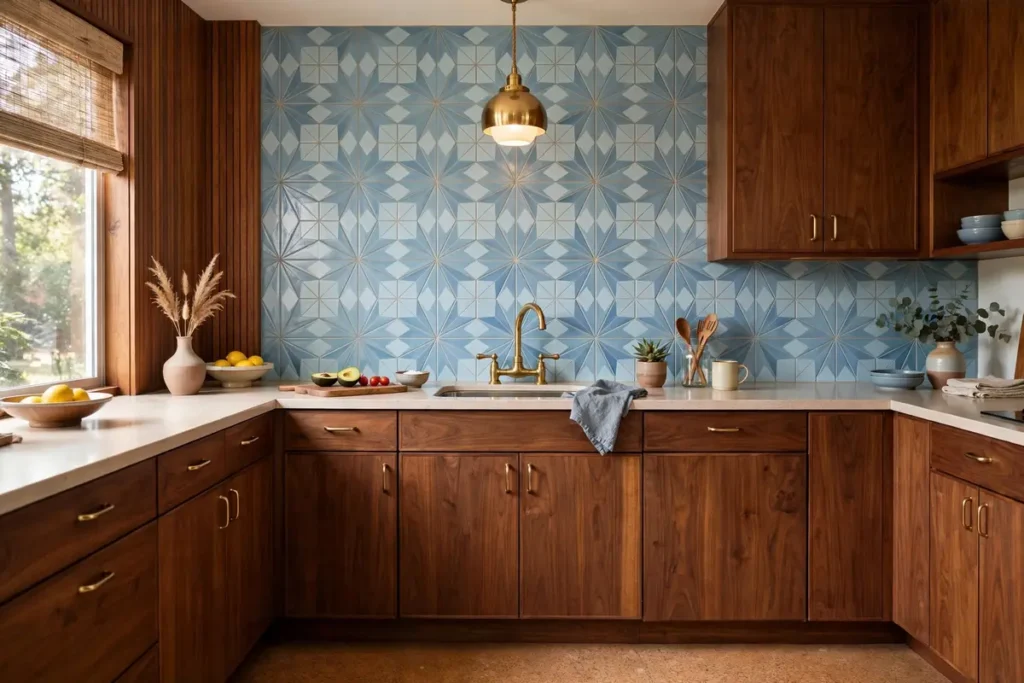
The backsplash is where MCM kitchens show their personality, because tile is one of the few places the style allows pattern. Geometric tiles, hexagons, diamonds, starbursts, and mosaics, are the most authentic choice, and they draw the eye without overwhelming the room. A starburst tile backsplash in soft blue, paired with brass pulls, is a textbook MCM combination.
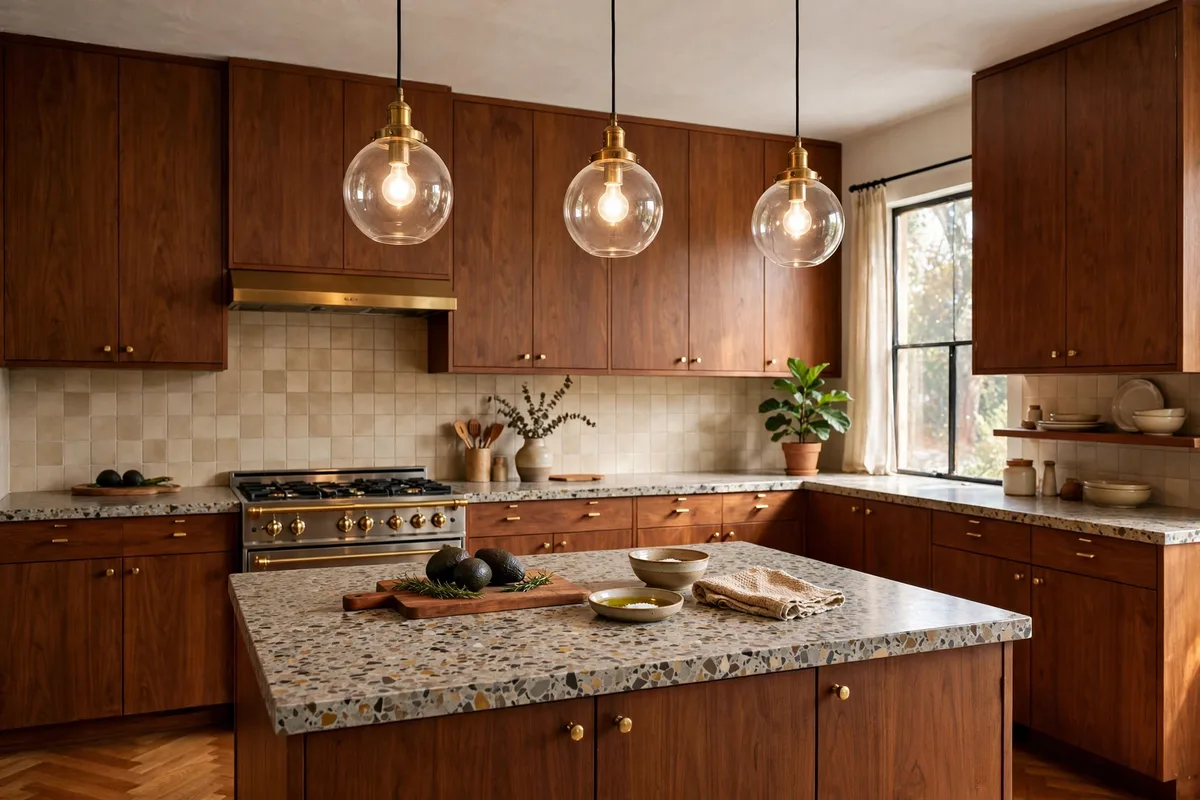
Terrazzo is the other signature surface. Its speckled finish reflects authentic 1960s materials, and as a backsplash it brightens the cooking zone while tying the cabinetry and island together. Simpler options suit quieter rooms: ceramic subway tile in muted greens, elongated subway tiles, and hand-painted ceramics all work, especially in small kitchens where a bold geometric pattern would dominate. A herringbone-patterned green backsplash adds depth and a retro touch while staying calm against walnut cabinets and brass hardware.
Countertops: Terrazzo, Quartz, and Butcher Block
Countertops in an MCM kitchen should be simple, durable, and honest. Terrazzo leads the retro choices: speckled, hard-wearing, and visually tied to the era. Quartz is the modern workhorse: white quartz counters keep the room bright, grey quartz grounds wood tones, and quartz in general resists stains far better than marble and handles daily use well. Butcher block is the warm option, and it pairs beautifully with minimalist white cabinetry and an orange accent wall. It is softer than stone and needs oiling, but it adds a warmth that stone cannot, and it suits the natural-material spirit of the style.
Colour blocking works on counters too. A kitchen that runs three quartz designs, black, white, and a mid-tone, in horizontal bands across the island and counters, creates a striking focal point without any extra decoration. The rule is the same as for wall colour: one bold move, everything else calm.
Islands and Peninsulas: The Social Centre
The island or peninsula is the social centre of an MCM kitchen, and it should be designed for people, not just prep. A continuous countertop that runs from the perimeter into the island gives a seamless prep surface. A peninsula, which keeps one end attached to the wall, suits smaller rooms and open plans where a full island would block movement.
Slatted wood on an island is a distinctive MCM detail: vertical wood slats across the island face, matched to walnut cabinetry, create depth and rhythm across the space. A muted green backsplash behind it, with brass fixtures and marble counters, completes a grounded retro palette. Seating at the island should be casual and comfortable: bar stools with tapered legs, wire-backed stools, and sculptural chairs all suit the style. Allow at least a 12-inch overhang for comfortable seating, and choose low-profile stools with tapered legs so sightlines stay open.
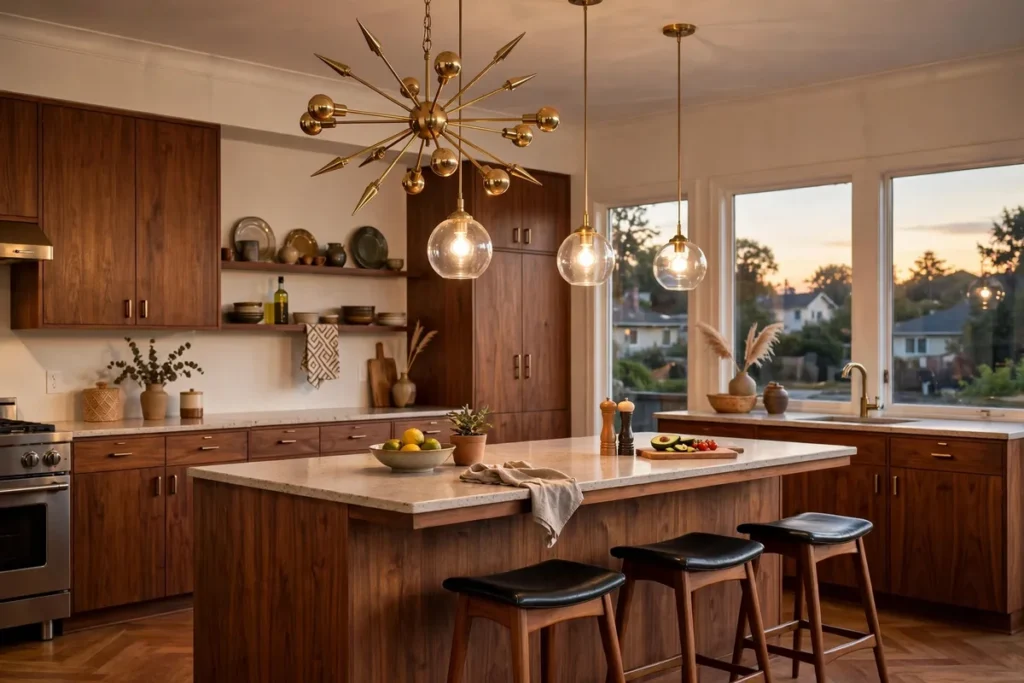
Lighting: Globe Pendants and Sputnik Chandeliers
Lighting is the jewellery of an MCM kitchen, and it is where retro style is most visible. Globe pendants are the classic: simple spheres of glass or opal that hang over an island or table and give a soft, even light. Sputnik chandeliers, with arms radiating from a centre like a starburst, are the bolder choice, and they suit dining areas and larger kitchens.
A brass starburst chandelier over a terrazzo counter, with globe pendants beside it, shows how two retro fixtures can share a room if they share a finish. Undercabinet LED lighting is the practical layer: it lights the worktop without adding a visible fixture, and concealed plug strips keep the backsplash clean. The rule for all of it: fixtures should be visible and beautiful, because in MCM design, lighting is decoration, not an afterthought.
Retro Seating: Tulip Tables, Eames Style, and Bar Stools
Seating is where MCM design shows its furniture heritage, and the icons are worth knowing. The tulip table, with its single pedestal base, anchors a breakfast nook without the visual clutter of four legs. A round Saarinen-inspired tulip table in a corner nook is a compact dining solution that feels unmistakably mid century.
Chairs matter as much as tables. Eames-style chairs, with moulded seats and tapered legs, are the most recognisable MCM seat, and they work at tables, islands, and breakfast bars. Chartreuse upholstered bar stools add a playful retro note against walnut cabinets. Wire-backed stools suit a more industrial-leaning MCM kitchen. Blue velvet stools with metal legs add colour and softness against wood. The dining area should feel connected to the kitchen, not separate from it: a sculptural wooden table with angular legs, paired with MCM dining chairs, creates a cohesive flow between cooking and gathering.
Open Shelving and Slatted Wood Details
Open shelving suits MCM kitchens because the style values display of honest materials over hidden storage. Floating wood shelves beside flat-panel cabinets keep daily dishes, glassware, and a few cookbooks visible, and they break up long runs of closed doors without adding visual weight. Integrated shelving within a cabinet run does the same job more quietly.
Slatted wood is the detail that elevates plain shelving: vertical wood slats on an island, a wall panel, or a room divider add rhythm and shadow, and they pair with walnut cabinetry to create a crafted, architectural feeling. Keep open shelves edited: a few ceramics, a plant, and daily glassware look intentional, while shelves packed with everything you own look like storage, not design. If you need more storage than open shelves allow, put it below the counter, where MCM design prefers it, and keep the walls calm.
Flooring: Wood, Terrazzo, and Patterned Tile
Flooring in an MCM kitchen should be natural, durable, and quiet enough to let the cabinets lead. Natural wood is the classic: warm planks that match or complement the cabinetry, refinished with a satin or semi-matte finish to highlight the grain. Terrazzo floors are the retro statement, speckled and hard-wearing, and they tie a kitchen to its 1960s roots. Patterned tile is the bolder option: geometric patterned flooring, in yellow, green, or neutral tones, ties a retro palette together and adds energy underfoot, while cement tile floors in grey tones suit a more muted MCM kitchen.
If hardwood floors already exist, refinishing beats replacing: it highlights the natural grain, costs less, and keeps the original character of the house. Whatever the floor, keep it in the same family as the cabinets. A wood floor with wood cabinets works when the tones differ enough to read as two materials, not one matched set.
Small MCM Kitchens: Galley, L-Shaped, and Minimal
Small kitchens suit MCM design surprisingly well, because the style is about simplicity and smart use of space. A galley plan works well for narrow rooms, keeping the work triangle tight and the sightlines open. L-shaped and U-shaped layouts support smoother workflow between cooking, prep, and dining in slightly larger rooms.
Compact layouts benefit from light walls, simple wood tables, and moulded chairs that keep the room open yet grounded. Below-counter storage matters more in a small MCM kitchen, because it keeps walls free and the room feeling taller. Colour discipline matters most in small rooms: one bold accent, like a yellow backsplash or a teal cabinet run, energises the space, while two or three bold colours compete and shrink it. Keep the base pale, the wood warm, and the bold colour to one surface, and a small MCM kitchen will feel lively, not cramped.
MCM Meets Contemporary: Black, White, and Colour Blocking
MCM blends gracefully with contemporary design, because both styles value clean lines. The classic blend is black and white: white quartz counters, black cabinetry or a black island, and a trio of pendant lights over the island. Brass pendants, warm wood tones, vintage-inspired stools, and a waterfall-edge island create a mix of MCM flair and contemporary marble-look surfaces. The waterfall edge, where the counter material runs down the side of the island, is a contemporary detail that suits MCM’s love of clean planes.
The blend works when each style owns its surfaces: MCM owns the wood, the brass, and the retro lighting, while contemporary owns the handleless planes, the waterfall edges, and the large-format surfaces. If both styles try to decorate the same surface, the room feels confused. If each has its own territory, the blend feels intentional.
MCM Meets Scandinavian: Blonde Wood and Simplicity
Scandinavian design is MCM’s closest cousin, and the blend is one of the easiest in kitchen design. Both styles love light wood, simple forms, and uncluttered rooms. Blonde wood, in cabinets, shelving, and beams, is the shared material, and it suits smaller or darker rooms better than deep walnut.
A blonde brick wall with exposed beams and a geometric brass chandelier shows the blend at its best: MCM warmth and geometry with Scandinavian lightness. The difference to respect is colour: Scandinavian rooms stay paler and quieter, while MCM rooms welcome a bold accent. In a blend, keep the bold colour to one surface, like a teal cabinet run or a green backsplash, and let everything else stay blonde and white. That way the room reads as both styles at once, not as neither.
Green Kitchens: Teal Cabinets and Scandi Blends
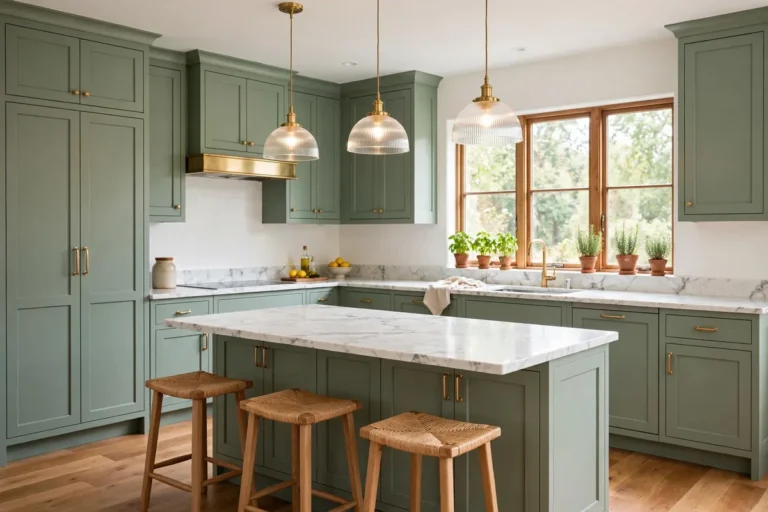
Green is the MCM accent colour that has lasted best, and it deserves its own note. Teal cabinets with subway tile and warm wood shelving create a striking focal point, especially when paired with a waterfall-edge quartz counter and geometric island tiles. The green feels retro without feeling dated, because it sits in the same family as olive and deep blue, the original MCM palette.
A green kitchen works in two directions. Deep green cabinets with a neutral backsplash feel dramatic and grounded, especially with brass hardware and marble counters. Muted green cabinet fronts with warm wood and open shelving feel softer and more approachable, and they suit open-plan rooms where the kitchen must sit calmly beside living space. Pair green with wood, not with more colour: warm timber, brass, and white counters let green be the star.
Original or Repro: Decorating With Retro Pieces
Decorating an MCM kitchen is a choice between original pieces and reproductions, and both are valid. Original decorative pieces from the 1950s and 60s honour the era directly: a vintage clock, a starburst mirror, an original pendant, or a set of ceramic dishes from the period. They carry patina and history that reproductions cannot fake. Reproductions make the look accessible: a light blue pendant inspired by Scandinavian design, Eames-style bar stools, or a tulip-style table give you the silhouette and the feeling at a fraction of the cost.
The rule for both is restraint. One or two hero pieces, with breathing space around them, read as design. A room full of retro objects reads as a collection, not a kitchen. Let the cabinets, the wood, and the light carry the style, and let the decor be the accent, not the argument. Vintage metal cabinets are the earliest version of the style: enameled steel sets from makers like Youngstown and St. Charles, made before wood slab doors became standard. Readers restoring an original often start with book-length histories of 1950s kitchens to date their details before buying anything.
Plants and Nature: Bringing the Outdoors In
Plants are essential in an MCM kitchen, because the style is built around a connection to nature. Floor-to-ceiling windows, open plans, and garden views are all part of the original idea, and plants inside the room complete it. Indoor plants and ceramic dishware add organic touches that soften flat cabinetry and hard surfaces.
If you have a garden or landscape around the kitchen, a transparent boundary wall between the terrace and the kitchen makes the garden part of the room. An herb garden on a terrace, with a transparent boundary to the kitchen, is the ideal version of the same idea. Choose plants that suit kitchen light and humidity: herbs on a sill, a trailing plant on open shelving, and one larger floor plant by a window. Keep them healthy and edited: a dead plant breaks the nature connection the whole style depends on, while three thriving ones make the room feel alive.
MCM Kitchen Mistakes to Avoid
The first mistake is theme overload: every surface retro, every object vintage, until the kitchen feels like a museum, not a room. The second is the opposite: flat cabinets with no wood warmth, no retro lighting, and no accent colour, which reads as plain modern, not mid century. The third is ignoring scale: oversized pendant lights in a small kitchen, or a tiny tulip table in a large open plan, both break the proportions the style depends on. The fourth is mixing too many wood tones: walnut cabinets, oak floors, teak shelves, and elm veneers in one room compete instead of harmonising. Pick one main wood and one supporting wood at most.
The fifth is fake materials done badly: printed wood grain on every surface, plastic brass-look hardware, and terrazzo-look laminate that reads as a photograph up close. One convincing lookalike is smart. The sixth is forgetting function: open shelving with nothing you use, a beautiful island with no prep space, or a striking backsplash behind a hob that cannot be cleaned.
MCM Kitchen on a Budget: Doors, Tile, and Lighting Swaps
MCM is one of the most budget-friendly styles to fake well, because its best details are surface swaps, not structural work. Swapping existing cabinet doors for flat-panel walnut or teak veneer gives you most of the look for far less than full cabinetry. Refreshing the backsplash with ceramic subway tile in muted greens or geometric mosaics is one of the most affordable retro updates. Lighting is the next highest-impact swap: globe pendants or a small sputnik chandelier instantly reinforce the mid century look without major construction.
Spend where you see it daily: cabinet doors, the backsplash, and the lighting. Save where it does not show: the carcass, the inside of cabinets, and the plumbing you are not moving. A good door, a good tile, and a good pendant make a budget kitchen feel mid century. The reverse is never true.
Restoring a Real Mid Century Kitchen: Keeping What Matters
Restoring a genuine mid century kitchen is different from building a new one in the style, because the original details are the value. Keep what is intact: original cabinetry, beams, windows, and tile, even if they need repair. Restore what is damaged carefully, choosing details that honour the home’s mid century roots rather than replacing them with generic modern equivalents.
The history is worth knowing. The mid century kitchen transformed from a functional room for labour, sometimes not even its own room, into a family hangout space. Counter heights were standardised at 36 inches in the 1950s, with sinks set there first and other counters following, appliances came in fashionable colours, and convenience foods changed how families ate. When restoration forces replacement, match the era, not the trend: flat-panel doors in the original wood species, tile in the original pattern family, and lighting in the original spirit will keep the room coherent. A generic modern replacement in a mid century shell is the fastest way to erase what made the house special.
Remodel Plan: Layout, Cabinets, Backsplash, Lighting, Floors
A remodel plan keeps an MCM project in order, because the style rewards sequence. First, define the layout: a galley plan for narrow rooms, L-shaped or U-shaped for smoother workflow between cooking, prep, and dining. Decide on open versus peninsula early, because it decides the wall and electrical work. Second, upgrade cabinets first, before surfaces: swap doors for flat-panel walnut or teak veneer, or replace the run if the carcass is failing. Third, refresh the backsplash in ceramic subway tile, muted greens, or geometric mosaics. Fourth, focus on lighting: globe pendants or a sputnik chandelier, plus undercabinet LEDs for work light. Fifth, refinish, do not replace, floors, with a satin or semi-matte finish that highlights the grain.
Do the work in that order and each step makes the next one easier: layout decides cabinet sizes, cabinets decide backsplash height, backsplash decides lighting placement, and floors go last so they are not damaged by the earlier work.
FAQs
How do I make my kitchen look mid-century modern?
Use flat-front cabinets in walnut or teak, natural wood tones, terrazzo or simple stone counters, and retro lighting like globe pendants. Add vintage appliances or geometric accessories sparingly, and keep hardware minimal.
What flooring is best for a mid-century kitchen?
Natural wood, terrazzo, patterned tile, polished concrete, and similar materials all suit the style. Refinished hardwood is often the best value, because it keeps the original character of the house while highlighting the grain.
What is a good backsplash for a mid-century kitchen?
Geometric tiles like hexagons, diamonds, or starbursts, elongated subway tiles, mosaics, and hand-painted ceramics all work. Muted greens suit calm rooms, while bold geometric patterns suit rooms where the backsplash is the feature.
What wood is best for MCM cabinets?
Walnut is the classic choice for its deep tone and grain. Teak is warmer and slightly golden. Oak and elm veneers are lighter alternatives that suit smaller or darker rooms. Pick one main wood and repeat it.
Can a mid century kitchen work in a small space?
Yes. Galley and L-shaped layouts, light walls, below-counter storage, and one bold accent colour keep a small MCM kitchen open and lively.
Should I buy original or reproduction MCM decor?
Both work. Original pieces carry history and patina. Reproductions give you the silhouette at lower cost. Use one or two hero pieces with breathing space.
How do I mix MCM with Scandinavian style?
Share the blonde wood, simple forms, and uncluttered rooms. Keep the bold MCM colour to one surface, like a teal cabinet run, and let everything else stay blonde and white so the room reads as both styles.
What lighting suits a mid century kitchen?
Globe pendants over islands and tables, sputnik chandeliers in dining areas, and undercabinet LEDs for work light. Brass finishes warm walnut kitchens.
Is terrazzo hard to maintain in a kitchen?
Terrazzo is hard-wearing and durable, but like stone it benefits from sealing, especially on counters. Use a penetrating sealer, not wax, clean with a neutral pH cleaner, and reseal every year or two. Sealed terrazzo handles daily kitchen use well and keeps its speckled retro character for years.
Can I restore a real mid century kitchen without losing its character?
Yes, if you keep what is intact and match replacements to the era: flat-panel doors in the original wood species, tile in the original pattern family, and lighting in the original spirit.
Get home ideas in your inbox
Practical home improvement ideas and DIY guides, once in a while. No spam.