Drainage System: How It Works, Types, Problems, and Fixes for Your Home
Water is quiet until it has nowhere to go. A working drainage system moves rainwater, groundwater, and wastewater away from your home before it can pool, seep, or flood. When that system fails, the damage shows up slowly at first: a damp basement corner, a crack in a foundation wall, a lawn that stays soggy for days after rain. This guide explains what a drainage system is, how its parts work together, which type fits which problem, and how to fix the most common failures, including a washing machine drain that keeps overflowing.
What Is a Drainage System?
A drainage system is a network of pipes, trenches, channels, and structures that collects water and carries it to a safe discharge point. Around a home it handles three kinds of water: rainwater from the roof and yard, groundwater that rises through soil, and wastewater from sinks, showers, toilets, and appliances. The goal is always the same: keep water away from the foundation, out of living spaces, and moving toward a place where it can soak in or flow away harmlessly. Without that network, water collects where it falls, and standing water is the starting point for almost every water problem a house can have.
How a Drainage System Works: Pipes, Gravity, and Flow
Most home drainage runs on gravity. Pipes are laid with a slight downward slope so water flows from higher ground to lower ground without a pump. Gutters catch roof runoff and send it to downspouts, which carry it to the ground system. Underground pipes then move it to a daylight outlet, a dry well, a storm drain, or a sewer connection. Where gravity alone cannot do the job, such as in a basement or a yard that sits lower than the street, a pump lifts the water to a point where gravity can take over. Vents let air into indoor drain lines so water flows smoothly instead of gurgling or siphoning, and traps hold a small amount of water that blocks sewer gas from entering the home. The two common trap shapes are the S-trap, generally used for toilets, and the P-trap, used for sinks, tubs, and showers; both do the same sealing job, but the P-trap is the standard shape in modern fixture plumbing. Drainage fittings are the smaller parts that make the network work: they connect pipes, let the system transition between pipe types and sizes, and seal off pipe openings that are not in use.
Surface Drainage Systems
Surface drainage deals with water you can see: rain running across a driveway, pooling on a patio, or sheeting over a lawn. It uses shallow channels, grates, and gently shaped ground to catch that water and send it away. Open drains, grassed waterways, and ground graded to slope away from the house are all surface methods. A cast in place trench drain across a driveway is a typical example. Surface systems are the first line of defense after heavy rain because they intercept water before it soaks toward the foundation.
Subsurface Drainage Systems
Subsurface drainage works below the surface, at root level and below, where you cannot see the water but the soil stays saturated. Perforated pipes buried in gravel trenches collect groundwater and carry it away, which keeps soil from staying waterlogged and pushing moisture through foundation walls. The French drain is the best known subsurface method. Because these pipes sit underground, they protect the parts of a home that surface drains cannot reach, and they often work together with surface drains as one combined system.
Slope Drainage Systems
Slope drainage uses the fall of the land itself. Pipes anchored along a slope guide water downward and away from a structure, moving it swiftly so it cannot pool against walls. This type matters most on hillside lots, where water naturally runs toward the building from higher ground. A slope drain only works if its outlet sits lower than its inlet, which is why checking the fall of the land comes before choosing any drain type. Where no lower outlet exists, water cannot be drained by gravity at all, and the fix has to change.
French Drains: How They Work and When They Fit
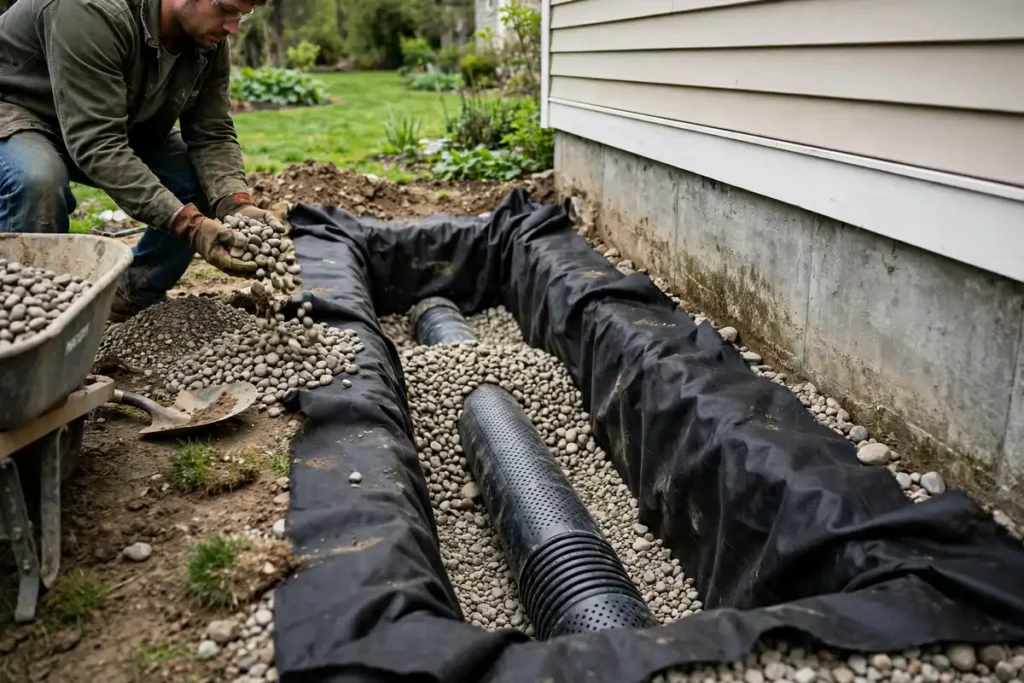
A French drain is a trench filled with gravel around a perforated pipe. Water seeps through the gravel into the pipe, and the pipe carries it away from the problem area. It fits best when the ground stays saturated below the surface, or when water seeps along a slope toward a foundation. It does not fit every wet yard. If water sheets across the surface into a low spot, grading usually fixes it faster and cheaper. If water collects at one point, a catch basin may be the better tool. A French drain also needs a working outlet: a lower point where the pipe can discharge by gravity, such as a ditch, a dry well, or a daylight opening at the edge of the property.
Channel and Trench Drains
Channel drains, also called trench drains, are long, narrow grates set into hard surfaces such as driveways, patios, and walkways. When a slab tilts toward the house, a channel drain cut across it stops the water and redirects it before it reaches the foundation or garage. Trench drains work the same way with a wider opening and higher flow capacity, which suits homes where flooding is a concern. Both types need a pipe connection that carries the collected water away, and both need their grates kept clear of leaves and debris so flow is not blocked at the surface.
Slot Drains
A slot drain is a slim cousin of the trench drain. Instead of a wide grate, it has a narrow channel opening that needs no drain cover, so it blends into patios, pool decks, and walkways with a subtle look. Stainless steel slot drains are used around homes for the same job as a trench drain: intercepting surface water on hardscapes and sending it to a pipe. The slim opening suits places where a wide grate would look out of place or catch feet and wheels, but it still needs the same pipe outlet and the same cleaning routine as any surface drain.
Catch Basins and Yard Drains
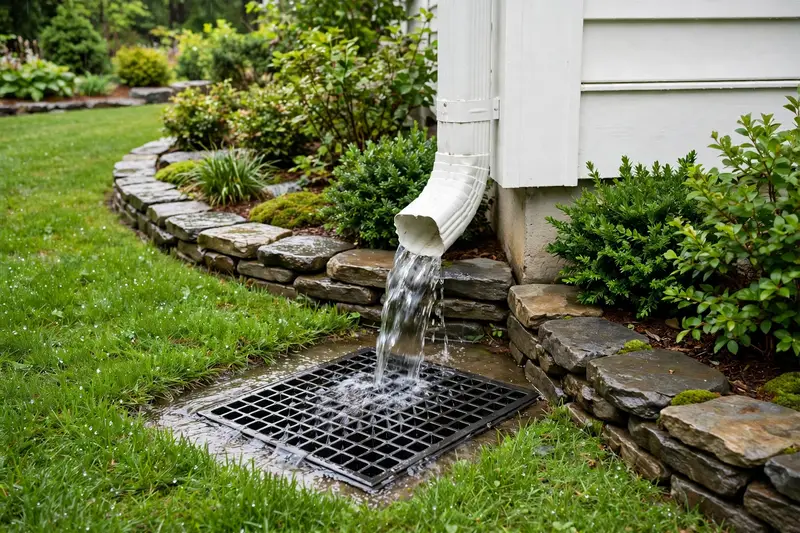
A catch basin is a box set into the ground at a low point, usually at the bottom of a downspout, with a grate on top. Water runs into the box and leaves through a buried pipe to a discharge point. That discharge point is often a pop-up emitter: a fitting at a low point of the system that stays closed and flush with the ground until water pressure pushes it open to release the collected water, then closes again so the lawn stays usable. Yard drains work the same way at spots in the lawn where flooding has been seen before, acting like outdoor versions of a shower drain. Both are point solutions: they collect water that arrives at one place rather than water spread across a whole area. That makes them the right fix when one dip, one downspout, or one patio corner causes the trouble, and the wrong fix when the whole yard stays wet.
Dry Wells and Dry Creek Beds
A dry well is an underground basin filled with rock that collects water and lets it percolate slowly into the surrounding soil. It suits yards where a pipe cannot reach a lower outlet, because the well itself becomes the discharge point. Subsurface storm chambers work on the same idea at larger scale: buried chambers collect stormwater underground and release it slowly, and some designs include sediment traps that improve water quality before release. A dry creek bed does a similar job on the surface: a shallow channel lined with rock that guides stormwater along a planned path to the edge of the property while looking like a natural landscape feature. Both handle volume by storing or slowing water, and both work best paired with other methods, such as a catch basin feeding the well or a French drain feeding the creek bed.
Gutters and Downspouts: Your First Line of Defense
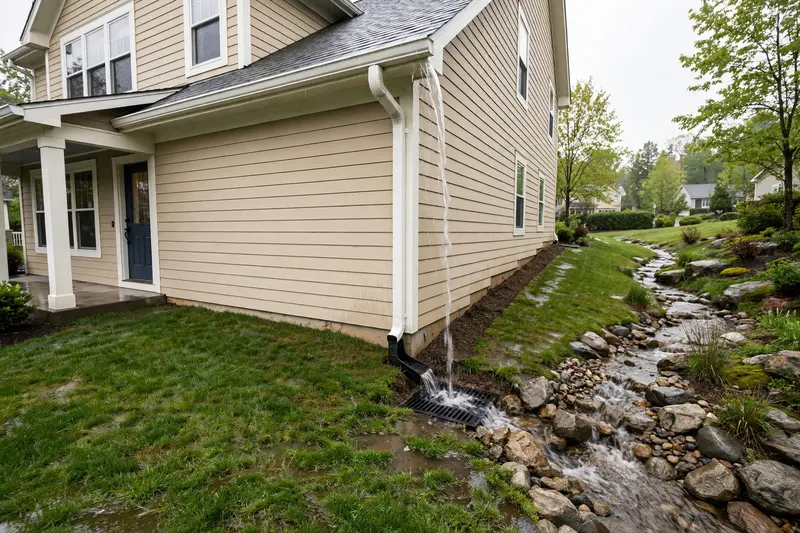
Gutters are where home drainage starts, because the roof collects more water than any other part of the property in a storm. A full set of properly sized gutters leads water to downspouts, and downspouts must carry it far enough from the house. Guides commonly recommend discharging downspouts at least 4 to 6 feet from the foundation, and up to 10 feet where the ground slopes or rainfall is heavy. Downspouts that dump right at the foundation line saturate the most vulnerable soil on the lot. Cleaning gutters and downspouts at least twice a year keeps that first line of defense open, since a clogged gutter sends roof water straight over the edge and down the walls.
Sump Pumps and Subsurface Tools
A sump pump sits in a pit at the lowest point of a basement or crawl space and pumps collected water away from the foundation to a discharge area. It is the tool of last resort when gravity cannot move water, and it is essential in homes with basements below the water table. Perforated drain pipes are its quiet partner underground, gathering water from the soil and feeding it toward the pit or the outlet. An outdoor sump pump system can play the same role in a yard that sits lower than its surroundings. Because a pump depends on power, a battery backup matters: a pump that stops in a power outage, exactly when storms are worst, leaves the basement unprotected.
Septic Systems and Sewage Treatment: Managing Wastewater
Not all drainage handles rain. Wastewater from toilets, sinks, showers, and washing machines needs its own path. Rural homes often rely on a septic tank, an underground tank that separates solids from liquids, lets bacteria break solids down over time, and filters liquid into the soil. Urban homes usually connect to a sewage treatment plant, which cleans wastewater from many homes through physical, chemical, and biological processes before releasing it to local waterways. Both systems keep dirty water out of groundwater and rivers, and both fail when the wrong things go down the drain: grease, wipes, and foreign objects block pipes and damage treatment alike.
Why Your Home Needs Proper Drainage
Proper drainage protects the three things water damages first: the foundation, the yard, and the health of the people inside. Water collecting against a foundation weakens it over time, seeps through cracks, and creates wet sill plates, wood rot, and mildew. Pooling water in the yard kills grass and plants, erodes soil, and draws mosquitoes and other pests. Standing water that freezes becomes a slip hazard, and damp indoor air feeds mold growth. A home with working drainage avoids most of these problems at once, because the same pipes that protect the foundation also protect the landscape and the indoor air.
Signs Your Drainage System Is Failing
Catching failure early saves the cost of foundation repair later, so it pays to look for warning signs during and after rain. Water pooling against the foundation hours after a storm, or standing water that does not disappear within a day or two, is the clearest sign. Inside, look for damp basement corners, a musty smell in the basement or crawl space, and white chalky staining on concrete walls, known as efflorescence, which appears when water evaporates and leaves mineral deposits behind. Outside, watch for cracks in foundation or exterior walls that widen over time, soil eroding or sinking near the house, soil pulling away from the walls, and downspouts that back up or overflow at the elbow. Any one of these signs is reason to inspect the system before the next storm season.
Which Fix Fits Your Problem? Source, Path, Low Point, Outlet
The most common drainage mistake is buying a fix before diagnosing the problem. Four clues, best observed during or right after hard rain, point to the right one. First, the source: a downspout, a neighbor's slope, a driveway, or groundwater itself. Second, the path: sheeting across the surface, running in a channel, or seeping up from below. Third, the low point: one dip, the foundation line, or the whole yard. Fourth, the outlet: a lower part of the property, a ditch, or a daylight point where a pipe can safely discharge. Match the fix to those four clues. Surface sheeting calls for grading, a single collection point calls for a catch basin, saturated ground calls for a French drain, and a downspout source may need only an extension. And if no lower outlet exists, no drain that depends on gravity will work: a yard below street level needs regrading or a pump, not a French drain.
| Drainage type | Best for | Watch out for |
|---|---|---|
| French drain | Saturated ground below the surface, seepage along a slope | Needs a lower outlet; fails if the trench has no slope or the fabric and gravel are wrong |
| Channel or trench drain | Hard surfaces tilted toward the house, driveways and patios | Grates must stay clear of leaves and debris |
| Slot drain | Patios, pool decks, and walkways where a wide grate would look out of place | Same pipe outlet and cleaning needs as a trench drain |
| Catch basin or yard drain | One low point, one downspout, one flooding corner | Only collects water at that point; it does not dry a whole wet yard |
| Dry well or storm chamber | Yards with no lower outlet for a pipe | Releases water slowly, so it must be sized for the volume it receives |
| Grading or swale | Surface water sheeting across the yard | Needs the code fall of 6 inches in the first 10 feet, or drains and swales where that fall is impossible |
DIY Yard Drainage Methods That Actually Work
Several yard methods from the guides are genuinely doable without a contractor. Sloping the ground away from the house is the first fix to consider, keeping at least 4 inches between the finished slope and the bottom of the siding, and using firm clay-like soil that packs tightly rather than loose topsoil or mulch that washes away. The International Residential Code (section R401.3) sets the underlying standard: lots must be graded so the grade falls at least 6 inches within the first 10 feet from foundation walls, with drains or swales where that fall is not possible because of lot lines or other barriers. Replacing hardscapes that tilt toward the house with crushed gravel or pea gravel lets water drain evenly instead of cascading to the foundation. A rain barrel beside a downspout stores roof water for garden use, though some areas regulate rainwater collection, so local rules should be checked first. Aerating the lawn and loosening compacted soil let water trickle down instead of pooling, and amending heavy clay with organic matter or pea gravel improves it further. A rain garden in a low spot, planted with deep-rooted natives, captures stormwater and lets it soak in, while a swale, a shallow grass-covered ditch along a natural slope, guides excess water to a safe place such as a garden or dry well.
French Drain Installation Mistakes to Avoid
French drains fail more often from installation mistakes than from bad materials, and video guides from experienced installers name the same errors again and again. The pipe must slope steadily toward its outlet, or water sits in the trench instead of leaving it. Perforated pipe belongs at the bottom of the trench, with gravel around it and filter fabric folded over the top so dirt cannot migrate into the stone and clog the system. Backfill matters as much as the pipe: for wet areas, coarse-grained soil is the right backfill material, while fine soil or clay packed over the trench blocks water from reaching the drain. A sock pipe used the wrong way, shallow trenches, and downspouts connected into a French drain all cause early failure: downspout water overwhelms a drain sized for groundwater. Cheap downspout extensions and bad connection points leak at the joints, and a system with no cleanouts cannot be serviced when it eventually clogs. Layering matters too: round drainage stone around the pipe, fabric over the stone, and a few inches of drainage sand above the fabric help surface water reach the system without carrying soil into it.
Washer Machine Drain: Standpipe, Hose, and P-Trap Problems
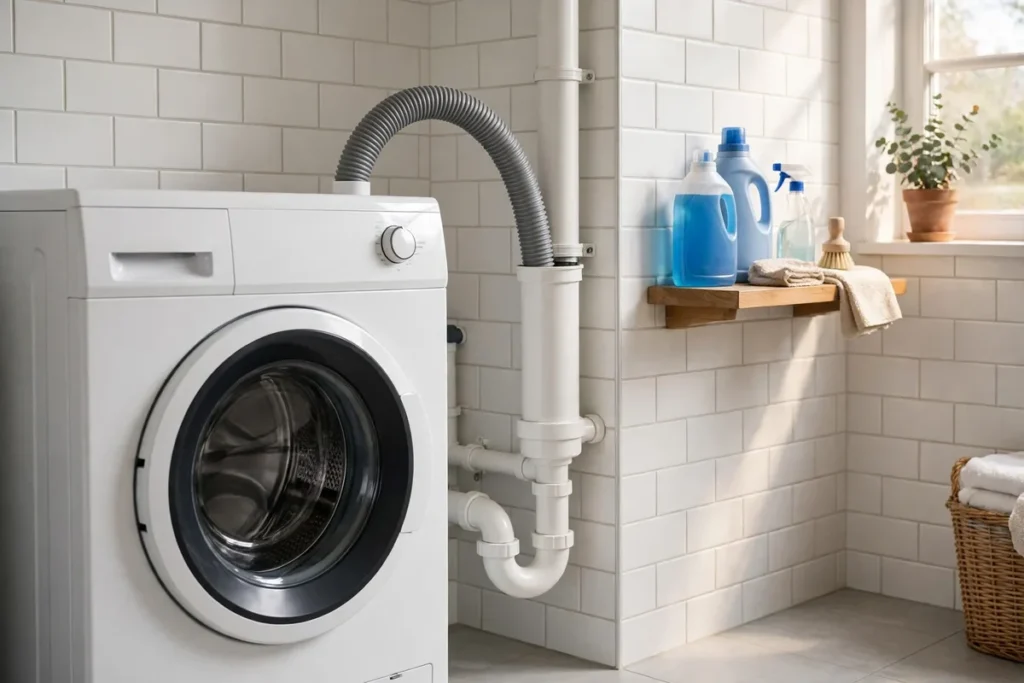
A washing machine drain is a small drainage system of its own, and it causes a large share of indoor drainage complaints. The washer pumps wastewater through a drain hose into a vertical standpipe, which connects to a P-trap that blocks sewer gas, and then to the home's drain system. When that standpipe overflows, the cause is almost always a partial blockage in the drain line, not a fault in the washer itself. Lint, detergent residue, and grease build a sticky sludge inside laundry lines, and guides report that modern high-efficiency washers can pump around 15 to 20 gallons per minute, which can overwhelm older or undersized lines. Three installation details prevent most overflows. The standpipe should be at least 2 inches in diameter and at least 18 inches tall above the trap, with the maximum height depending on the plumbing code adopted locally: 30 inches under the Uniform Plumbing Code and 42 inches under the International Plumbing Code. The drain hose should extend only 6 to 8 inches into the standpipe according to plumbing guides, leaving an air gap, because a hose pushed too far down seals the pipe and pushes water back up; note that some washer manuals are stricter, with Whirlpool manuals flagging a hose extending farther than 4.5 inches into the standpipe as an installation fault, so your own washer manual has the final word. And the line needs a vent, because without air behind the water, draining creates a vacuum that causes gurgling and slow flow. When a washer will not drain at all, check in order: a kinked or pinched hose, a clogged hose, a blocked pump filter, often called a coin trap, behind the small panel at the front bottom of the machine, a foreign object jamming the pump, a lid switch or door lock fault, and finally a failed drain pump. Many machines show drain error codes, such as OE on LG models, 5E (sometimes shown as SE) or 5C on Samsung models, and F9E1 on Whirlpool and Maytag models. These codes are confirmed on the manufacturers' own support pages: LG lists OE as a drain issue, Samsung lists 5E and 5C as drain errors, and Whirlpool lists F9E1 as a drain pump system error. Chemical drain cleaners are not recommended for washer drains, since harsh chemicals can damage plastic pipe without clearing the sludge; an enzyme cleaner with a hot water flush is the gentler option guides suggest.
Common Drainage Problems and How to Fix Them
Clogged drain pipes are the most common drainage problem in any part of the system, from kitchen drains to main sewer lines. Leaves, grease, hair, and dirt build up over time, causing slow drainage and unpleasant odors. Regular cleaning prevents most clogs, and a drain snake clears one that has already formed. Tree roots are a harder problem: roots grow into cracks in older clay or cast iron pipes looking for water, and over time they can block the pipe completely or break it. A professional root removal service can clear roots and repair or replace the damaged section, and root-resistant pipe is the better choice when replacement happens. Improper drainage slope is a third common failure: pipes laid without the correct fall let water pool or flow backward, and the fix is regrading the land or relaying the pipe at the right slope. Excess moisture in soil around the foundation brings mold and structural damage if left alone, and French drains or sump pumps redirect that moisture before it worsens. Sewer line breaks and septic tank leaks are the most serious cases, since leaking sewage contaminates the ground; a plumber locates the leak by isolating the line, then digs to repair or replace the damaged section.
Drainage System Maintenance: Keeping Water Flowing
A drainage system needs little attention, but the attention it needs is regular. Clear gutters and downspouts at least twice a year, and keep channel drain grates and catch basin grates free of leaves and debris so surface water can enter the system. Watch pipes for slow drainage, which is the earliest sign of a developing clog, and keep trees with aggressive roots away from buried lines where possible. Check the discharge point after heavy rain to confirm water actually leaves the property instead of pooling at the outlet. Inspect basement walls for new damp spots or efflorescence each season, since those marks show a problem while it is still small. A system that is checked this way rarely fails suddenly, because every major failure gives small warnings first.
When to Call a Professional
Some drainage work stays safely in DIY territory, and some does not. Call a professional when water keeps returning after surface fixes, which usually means the buried perimeter drain has failed, or when the foundation shows structural distress such as horizontal cracks or wide stair-step cracks in block walls. Persistent basement flooding during every rain event suggests hydrostatic pressure or a collapsed exterior drain, both beyond DIY repair. Any project that involves digging should start with a call to 811 to have utility lines marked, since buried electric, gas, and water lines turn a trench into a hazard. A drainage contractor or landscaping professional can also diagnose problems that look alike but need different fixes, such as a high water table versus a broken pipe, before money is spent on the wrong one.
FAQs
What is the importance of a drainage system?
A properly designed drainage system protects your home from water damage, structural erosion, and mold growth. It channels excess water away from foundations, reducing the risk of flooding and long-term deterioration. Drainage is essential for a safe, dry property.
What is the goal of a property's drainage system?
The main goal is to safely redirect rainwater and groundwater away from the structure. This prevents foundation damage, soil erosion, basement flooding, and landscape deterioration, preserving the longevity of both your home and yard.
How do I know if my drains are blocked?
Common signs are sinks that drain slowly, toilets that overflow, a sewage smell around drains, and gurgling sounds caused by trapped air. Any of these means a blockage is forming somewhere in the line and should be cleared before it becomes a backup.
Why is my bath or shower draining slowly?
A slow bath or shower drain is usually a partial blockage made of hair and skin deposits in the pipe. Regular cleaning keeps the pipe clear, and a drain snake removes a blockage that cleaning cannot reach.
Does every soggy yard need a French drain?
No. A French drain fits when the ground stays saturated below the surface or water seeps along a slope. If water flows across the surface into a low spot, grading may fix it. If it collects at one point, a catch basin may be better. If a downspout is the source, an extension may be enough. Reading the water path first prevents digging the wrong fix.
How far should downspouts drain from the house?
Guides commonly recommend discharging downspouts at least 4 to 6 feet from the foundation, and up to 10 feet where the ground slopes or rainfall is heavy. Downspouts that release water right at the foundation saturate the soil in the most vulnerable area of the property.
Why does my washing machine drain overflow from the standpipe?
Standpipe overflow almost always signals a partial blockage in the drain line, not a fault in the washer. Lint, detergent residue, and grease build sludge inside laundry lines, and the usual installation faults are a standpipe that is too short, a drain hose pushed too far into the pipe, or a missing vent. Pulling the hose back so only 6 to 8 inches sit inside the standpipe solves the problem more often than owners expect, though some washer manuals set a stricter limit, so check your own manual.
What is the best gravel to use for yard drainage?
Pea gravel is the type most often recommended for yard drainage. Its small size lets water pass through evenly, and it is also used to amend heavy clay soil so water drains instead of pooling on the surface.
Do rocks help with drainage?
Yes, when they are placed to guide water. Rock arranged as a channel, bed, or border directs flow where it should go instead of letting it spread, and stone needs little maintenance and lasts for years in the ground.
What material is the best backfill for wet areas?
Coarse-grained soil is the best backfill material for wet areas. Fine soil and clay pack tightly and block water from reaching the drain, while coarse material lets water pass through to the pipe or trench.
Get home ideas in your inbox
Practical home improvement ideas and DIY guides, once in a while. No spam.