Wood Joinery: Types, Strength, and How to Choose the Right Joint for Your Project
Two pieces of furniture can look identical in a photograph and behave completely differently in a home. One stays square and tight for decades. The other wobbles, its drawers stick, and its corners open a little more every year. The difference is rarely the wood or the finish. It is the joinery: how the parts are connected, and whether each connection suits the job it must do.
This guide walks through the main types of joinery, from fast beginner joints to the strong traditional ones, and shows which joint suits each job.
What Is Wood Joinery?
Wood joinery is the craft of connecting pieces of wood into one structure. Sometimes the shape of the wood itself does the holding, with interlocking parts that resist pulling apart. Sometimes glue, dowels, biscuits, or screws do it, or several methods at once. A joint is a decision about strength, movement, appearance, and repair. Wood swells in humidity and shrinks in dry heat, so a good joint holds parts together while letting the wood move. Mortise-and-tenon joints appear in furniture from ancient Egypt and China, and joinery became a specialized craft by the Middle Ages. Joinery usually means workshop made components, while carpentry covers on site construction and installation.
Why the Joint Matters More Than the Wood
A beautiful board cannot rescue a weak joint, and a plain board can last generations with well chosen, well cut joints. Joints decide whether a table resists racking, whether a drawer still slides after ten thousand pulls, and whether a chair stays silent. They also decide repairability: a traditionally jointed piece can often be taken apart, reglued, and used again, while a stapled piece is much harder to fix. Wood and finish are easy to see; joints are harder to check and say more about lifespan.
Two Families: Cabinetry Joints vs Furniture Joints
Cabinetry joints belong to pieces with support behind them, such as built in cabinets and bookcases. Furniture joints belong to free standing pieces, such as chairs, tables, and bed frames, which must support themselves. A wall hung cabinet borrows strength from the wall, while a chair gets no help. So a dado or biscuit joint that suits a cabinet may be too weak as a chair leg’s main joint. Several joints below are called cabinet joints or furniture joints for exactly this reason.
Fast and Easy Joints for Beginners
Not every project needs a hand cut dovetail. Shop shelving, simple boxes, and built in cabinets are often built with fast joints that trade some strength for speed. These start with square cut ends, called butt joints, plus a reinforcement system: glue, screws, pocket holes, biscuits, or dowels. They need only basic tools, and they teach the two skills every joint depends on: cutting square and gluing cleanly. Move to interlocking joints when strength or appearance demands it.
Butt Joints: The Simplest Start, and Why They Need Help
A butt joint presses two pieces together face to face or end to face, with no interlocking cut. It needs nothing more than a saw that cuts square, and it is the weakest joint, because only glue and fasteners hold it. End grain is the problem: it soaks up glue and leaves a starved bond. Use plain butt joints only for low stress work, such as simple boxes or covered framing. Where a joint carries load, pull, or racking, reinforce it with screws, dowels, biscuits, or a different joint.
Pocket-Hole Joints: Fast, Hidden, and Cabinet Friendly
A pocket-hole joint drills an angled hole into one board and drives a special screw into the mating board. The screw enters from inside the piece, such as inside a cabinet, and passes through end grain into long grain, where it grips far better. It is fast, strong for cabinet work, and easy to hide on unseen faces. A jig makes drilling repeatable, and screws pull the joint tight as driven. The trade off is appearance: holes show on one face unless plugged, so pocket holes suit built ins and shop furniture better than fine furniture.
Dowels: Stronger Than They Look
A dowel joint glues small hardwood cylinders into matching holes in both pieces. Dowels are quick, versatile, and genuinely strong when holes line up. Alignment is the whole challenge: a dowel even slightly off will fight the mating piece. Jigs solve most of this, cutting a row of holes in one setup, and a plywood template does the same for repeated work. Dowels suit moderate size projects best. On a very large project, keeping many holes aligned gets fussy, but for most furniture a drill and a simple jig are enough.
Biscuits: Alignment First, Strength Second
A biscuit is a small pressed wafer, usually beech, that fits slots cut with a biscuit joiner. Parts are marked with tick marks, slots are cut in seconds, and biscuits swell slightly with glue, tightening the joint. Biscuits excel at alignment, keeping boards flush in a tabletop glue up, and they add useful strength in cabinet work. They do not go deep into the wood, so they cannot replace a structural joint in free standing furniture. Treat biscuits as alignment with a bonus, not as the main load bearing connection.
Glue: The Joint You Cannot See
In many joints, glue does more work than the eye suggests. A glued long grain to long grain surface can be stronger than the surrounding wood, which is why edge glued panels and well fitted mortise-and-tenon joints hold so well. Two conditions decide success: surfaces must be flat, straight, and clean, and clamp pressure must be strong and even. Glue fails most on end grain, which absorbs it before bonding, and in loose joints, where glue must fill a gap instead of bonding touching surfaces. Standard wood glue suits indoor furniture; outdoor projects need a water resistant rating.
Screws, Nails, and Fasteners vs Real Joinery
Screws and nails are fasteners, not traditional joints, but the distinction matters in practice. A screw acts like a metal dowel when used well: a clearance hole lets only the head pull on the first piece, while a pilot hole lets threads grip the second without splitting it. Fasteners grip at single points, while a glued interlocking joint grips across a whole surface. That is why a well glued interlocking joint can outlast a screwed one, and why traditional furniture avoids visible hardware. Fasteners still win for speed, shop furniture, and joints that may need to come apart again.
Rabbets, Dadoes, and Grooves: The Cabinetmaker’s Slots
Three related cuts form the backbone of cabinet work, named by where they sit. A rabbet is a square notch along the end or edge of a piece. Rabbet both sides of an edge and you form a tongue. The mating slot is called a dado when cut across the grain, such as for a cabinet shelf, and a groove or slot when cut along the grain. These joints suit built in cabinets, where wall, floor, and face frame all help, and they align parts beautifully. As a free standing piece’s main joint they are usually too weak alone, so pair them with screws, dowels, or a stronger joint.
Tongue-and-Groove: Panels That Stay Aligned
Tongue-and-groove joins boards edge to edge, a tongue fitting a groove along the boards’ full length. The long grain glue surfaces make it very strong, and it keeps panels, tabletops, cabinet backs, and floors aligned at their seams. The same idea appears in frame-and-panel construction, where a panel floats inside a frame of stiles and rails instead of being glued tight. That float is deliberate: it lets the panel expand and contract with the seasons without pushing the frame apart.
Lap and Bridle Joints: Frames That Overlap
Lap and bridle joints join pieces at right angles into frames, such as face frames, door frames, and table bases. A lap joint notches each piece so the two overlap flush. A bridle joint notches both sides of one piece into a tongue, slotting the other to receive it. The broad mating cheeks are long grain to long grain, so they hold glue very well, and a well clamped lap or bridle joint is extremely strong. They need only square notches, and they produce frames that stay square under load.
Splines and Keys: Reinforcing Miters
Splines and keys are thin wood pieces set into slots, most famous for saving miter joints. A spline runs down a joint’s length, joining two slotted pieces without a tongue and groove. A key is shorter, often set across a miter, adding strength and a decorative detail in contrasting wood. Hidden splines may be hardboard or thin manufactured board; visible keys are solid wood, fitted after slots are cut. Either form turns a weak miter into a joint that survives real use.
Miter Joints: Clean Corners, Weak Alone
A miter cuts board ends at an angle, usually 45 degrees, meeting in a clean corner with no end grain showing. That look is why miters dominate picture frames, trim, and display corners. Strength is the trade off: angled faces mix end grain with long grain, so glue holds only modestly, and seasonal movement can open the corner. For light duty frames, a glued miter is fine. For weight or knocks, reinforce with splines, keys, biscuits, or dowels. A long edge miter, used for hollow columns, is long grain to long grain and much stronger.
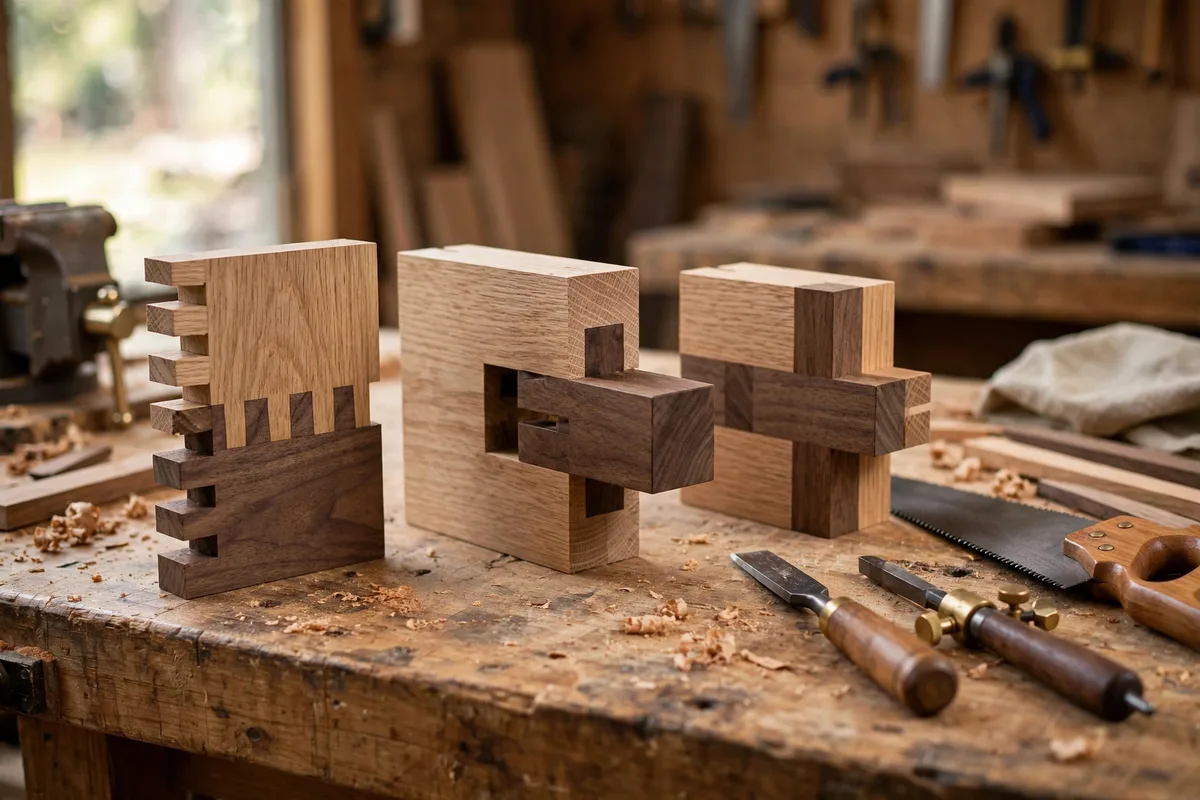
Box (Finger) Joints: Corners With Maximum Glue Surface
A box joint, also called a finger joint, joins wide board ends with rectangular interlocking fingers. More fingers mean more long grain cheek surface for glue, and a stronger corner. Wide fingers on Arts and Crafts cabinets are often peg reinforced, while fine even fingers suit minimalist boxes. Box joints serve small boxes, drawers, and carcasses, and are easier than dovetails: square fingers come from a table saw jig or a router template, repeating exactly.

Dovetail Joints: The Drawer Joint That Resists Pulling Apart
A dovetail uses angled, wedge shaped tails on one board locking into pins on the other. The angle is the point: once assembled, the joint cannot pull apart in the direction a drawer is pulled daily, because angled tails wedge against pins. Hence dovetails are the classic drawer joint, seen also on boxes and carcasses. Tails are the flared pieces; pins are the angled fingers between them. Through dovetails show on both faces and suit boxes and cabinets. Half-blind dovetails show on one edge only, ideal for drawer fronts. A well cut dovetail needs little more than glue, because geometry does the holding. Japanese practice marks dovetail slopes at 70 to 75 degrees.
Mortise-and-Tenon Joints: The Frame Joint That Resists Racking
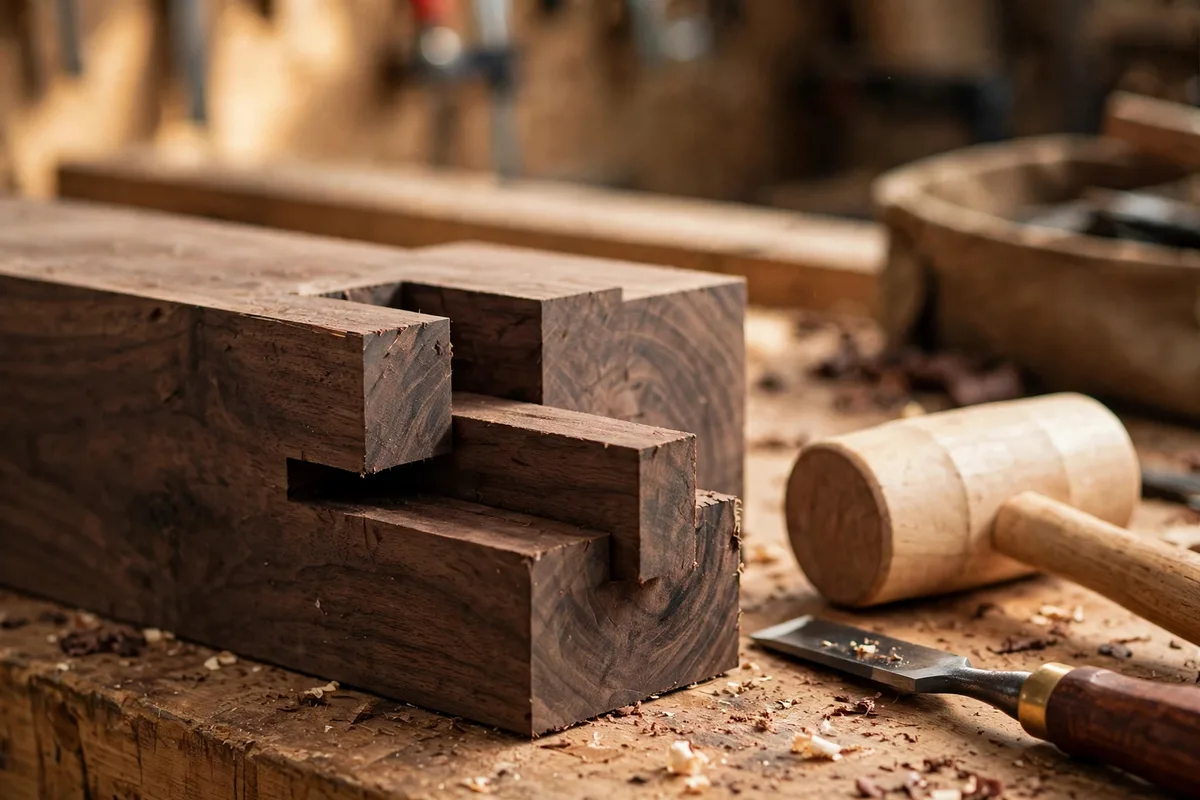
If dovetails own drawers, mortise-and-tenon joints own frames. A tenon, a rectangular projection on one board’s end, fits a mortise, a matching hole in the other board. The tenon’s cheeks meet the mortise walls long grain to long grain for most of the glue strength, its shoulders close the joint cleanly, and the fit resists racking, the sideways twist that loosens chairs and table bases. Mortise walls must not be so thin that the tenon flexes them outward. It is the standard joint for chair legs, table aprons, door frames, and bed frames. A blind mortise hides the tenon inside the mating piece. A through tenon passes through, showing on the far side, where it can be wedged or pinned. Draw boring reinforces further: peg holes drilled slightly offset pull the joint tighter as the peg is driven.
Loose Tenons and the Domino System: Modern Mortise-and-Tenon
A loose tenon keeps the mortise-and-tenon idea but changes how the tenon is made. Instead of shaping a tenon on one board, separate tenons fit mortises cut in both mating boards. Strength is close to traditional mortise-and-tenon, since glue surfaces and fit are the same, while work is simpler: cut accurate butt joints, then matching mortises. The best known system is the Festool Domino, a tool like a biscuit joiner that cuts mortises instead of shallow slots, with premade tenons to fit. Loose tenons suit panel, frame, and drawer joints, a practical middle path to mortise-and-tenon strength.
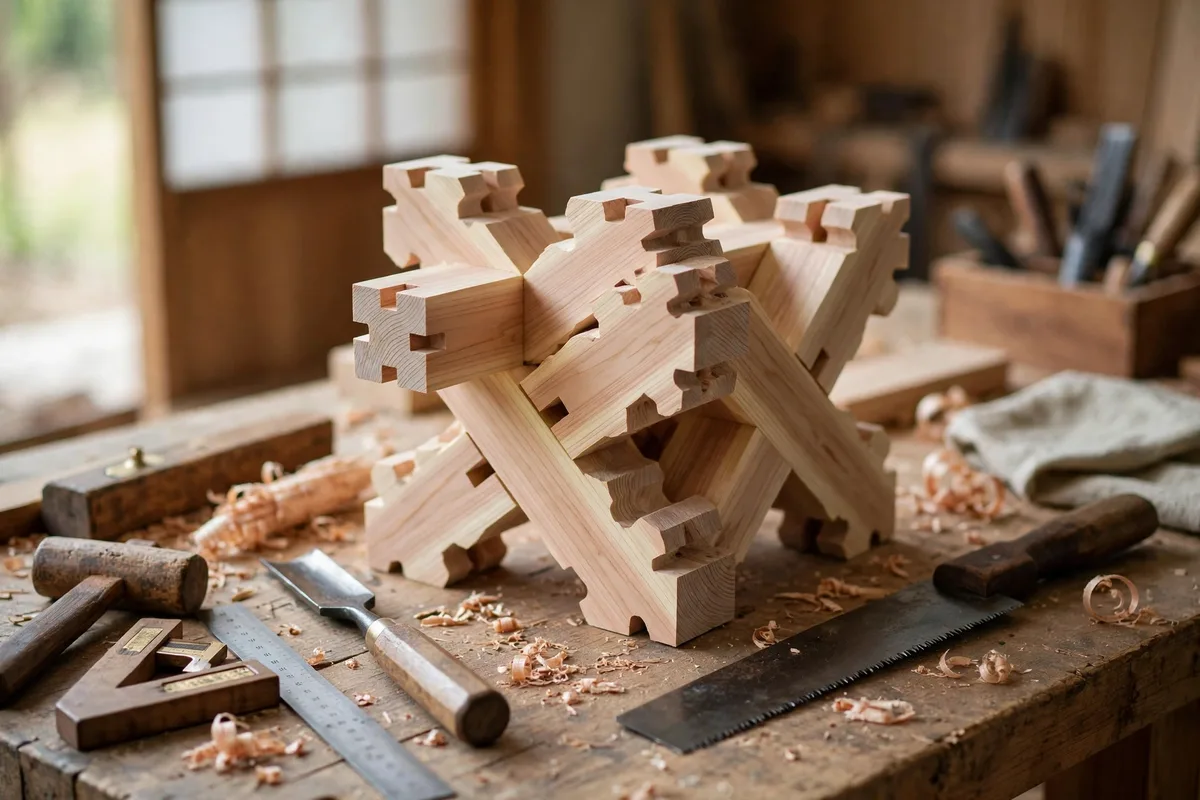
Japanese Joinery and Sashimono: Joints Without Nails or Screws
Japanese joinery, in timber building called sashimono, connects wood to wood with no nails or screws, using interlocking shapes developed over centuries of temple, house, and bridge building. Joints move with timber as it expands, contracts, and settles, suiting strong seasons and earthquakes, and the joint itself becomes part of the beauty. Familiar forms carry Japanese names: miter is tome-tsugi, half-lap is aikaki-tsugi, box is kumi-tsugi, dovetail is ari-tsugi, mortise-and-tenon is hozo-tsugi, plus variations like the mitered half-lap and five finger box joint. Hand cutting rests on few tools: sashigane square and kebiki marking gauge for layout, nokogiri pull saw, nomi chisel, genno hammer, and kizuchi wooden mallet for seating pieces without bruising. Good habits transfer everywhere: fine lines, one reference face, a marked waste side, and paring from both faces.
How to Choose the Right Joint for Your Project
Start with the force the joint must resist, and ask four questions. First, what force: racking in a chair frame, pulling in a drawer, shear across a shelf, or almost nothing in trim? Mortise-and-tenon resists racking best, dovetails pulling best, lap joints shear well. Second, will it be seen? A dovetail or keyed miter earns display; a pocket hole or biscuit belongs hidden. Third, what tools and skill do you have? Pocket holes, dowels, and biscuits need basic tools and forgive small errors; hand cut dovetails and mortise-and-tenon joints reward practice. Fourth, what family is the piece: a wall supported cabinet can use lighter joints than a free standing chair.
| Joint | Best for | Strength note | Watch out for |
|---|---|---|---|
| Butt | Low stress parts, covered framing | Weak alone, glue and fasteners only | End grain starves glue |
| Pocket-hole | Cabinets, face frames, shop furniture | Strong and fast for cabinet work | Holes visible on one face |
| Dowel | General furniture of moderate size | Strong when holes align exactly | Misaligned holes weaken the joint |
| Biscuit | Panel glue ups, cabinet alignment | Good alignment, moderate strength | Shallow, not structural alone |
| Rabbet, dado, groove | Shelves, cabinet carcasses | Strong for alignment in cabinets | Weak as a main furniture joint |
| Tongue-and-groove | Panels, tabletops, cabinet backs | Very strong long grain glue surface | Needs accurate milling |
| Lap and bridle | Frames, face frames, table bases | Very strong when clamped well | Needs square, clean notches |
| Miter | Picture frames, visible corners | Clean look, weak with glue alone | Opens with seasonal movement unless reinforced |
| Box (finger) | Boxes, drawers, carcasses | Strong, large glue surface | Needs an accurate jig or template |
| Dovetail | Drawer boxes, fine boxes, carcasses | Excellent resistance to pulling apart | Slowest to cut by hand |
| Mortise-and-tenon | Chairs, tables, beds, door frames | Best resistance to racking | Loose fit leaves only glue holding it |
| Japanese sashimono | Timber frames, fine furniture, display pieces | Strong, flexible, no metal | Demands the highest hand skill |
Common Beginner Mistakes That Weaken Any Joint
Most failed joints fail for a handful of repeatable reasons. First, a loose fit: an oversized mortise leaves the joint relying on glue alone, which the mechanical fit was supposed to prevent. Second, trusting end grain glue, in a plain butt joint or unreinforced miter, where glue soaks in and the bond starves. Third, ignoring wood movement: gluing a panel tight in a frame leaves seasonal swelling nowhere to go, and an unreinforced miter opens. Fourth, skipping the dry fit: assemble without glue first, check square and gaps, then glue. Fifth, mismatched glue and clamping: too little pressure weakens the bond, too much on soft woods crushes fibers. Identical looking joints can thus perform very differently, because moisture, glue choice, clamp pressure, and fit matter as much as the cut’s shape.
How to Spot Quality Joinery When Buying Furniture
You do not need a workshop to judge joinery in a showroom. Price often reflects hand work hidden in corners and drawer boxes, not just the visible finish. Open every drawer and check the corners: tight, clean dovetail or box joints say more than a polished face panel. Rock tables and chairs gently; they should feel rigid, not twist. Run a finger along visible corners and miters; gaps feel like tiny steps. Look underneath and inside, where shortcuts hide: staples where dowels should be, thin reinforcement, rough fitting, and excess glue squeeze out near dovetails and frame corners all point to rushed assembly. Check drawer boxes are solid wood and grain lines up across joints. A maker who can explain why a joint was chosen for that part is worth listening to.
FAQs
Which wood joint is the strongest?
There is no single answer, because strength depends on the force. For racking in a frame, a well fitted mortise-and-tenon is the standard. For being pulled apart, as in a drawer, a dovetail resists best. For shear, a lap joint with grain running in opposite directions performs very well.
Are dowel joints stronger than pocket holes?
Tests disagree, because the setups differ. In one home test on spruce, reported by Woodgears, unglued pocket screws failed well below dowel joints in the same setup. In a shear test cited elsewhere, a pocket screw joint failed at a higher load than a comparable mortise-and-tenon joint. Dowels tend to win on glued alignment and clean appearance, pocket holes on speed and clamping force, and both are excellent for cabinet work.
Are wood joints stronger than screws?
Sometimes, and it depends on the joint and the wood. An interlocking joint with a large glued long grain surface, such as a dovetail or a mortise-and-tenon, can be stronger than screws, which grip only at single points. But a badly cut or badly glued traditional joint loses to a well executed screwed joint, because glue quality and fit matter more than the joint name.
What is the simplest joint for a beginner?
The butt joint, two square cut pieces pressed together, is the simplest joint of all, and the right place to learn cutting square and gluing cleanly. For a first piece of furniture, a butt joint reinforced with pocket screws or dowels is the practical next step: no interlocking cuts, quick assembly with basic tools, and strong enough for cabinets, shelves, and shop furniture.
Can I cut joints without a table saw?
Yes. A hand saw, a chisel, a marking gauge, and a way to hold the work will cut every basic joint in this guide. Table saws and jigs make repeated cuts faster and more consistent, especially for box joints and dovetails, but they are not a requirement for starting.
What is sashimono?
Sashimono is the traditional Japanese carpentry technique of building structures with interlocking wood joints and no nails. Used for centuries in temples, shrines, houses, and bridges, many such structures have stood for hundreds of years.
Do I need dovetails for fine furniture?
No. Dovetails are a hallmark of fine furniture, but they are not the only way to build it well. A combination of rabbets and small dowels, simple box joints, or loose tenon joints can be just as strong and attractive. Choose the joint that fits the piece, your tools, and your skill, rather than treating one joint as a requirement.
Why do miter joints open up over time?
Miter joints open because their angled faces mix end grain with long grain, so glue holds them only modestly, and because wood moves with the seasons, swelling and shrinking across the corner. Splines, keys, biscuits, or dowels across the miter give it the mechanical help glue alone cannot provide.
Does visible joinery always mean better joinery?
No. Visible joinery can signal craftsmanship, especially in drawers and exposed frames, but some of the best construction is hidden inside the piece. What matters is whether a joint is clean, consistent, and suited to its load. A visible gap is a warning sign, but visibility alone proves nothing.
Should wood species matter more than joinery?
Both matter, but joinery is usually the first place to judge structure. A strong species will not rescue a sloppy joint, and a well made joint cannot fully overcome a bad material choice. Ask instead how species and joint work together for the room, humidity, and use.
How long should quality joinery last?
There is no single number, because species, use, moisture, and care all matter. A well made joint, matched to its job and kept in a normal indoor environment, should stay tight far longer than a weak joint that only looks good on day one. Good joinery starts with the right build and continues with sensible care.
Get home ideas in your inbox
Practical home improvement ideas and DIY guides, once in a while. No spam.